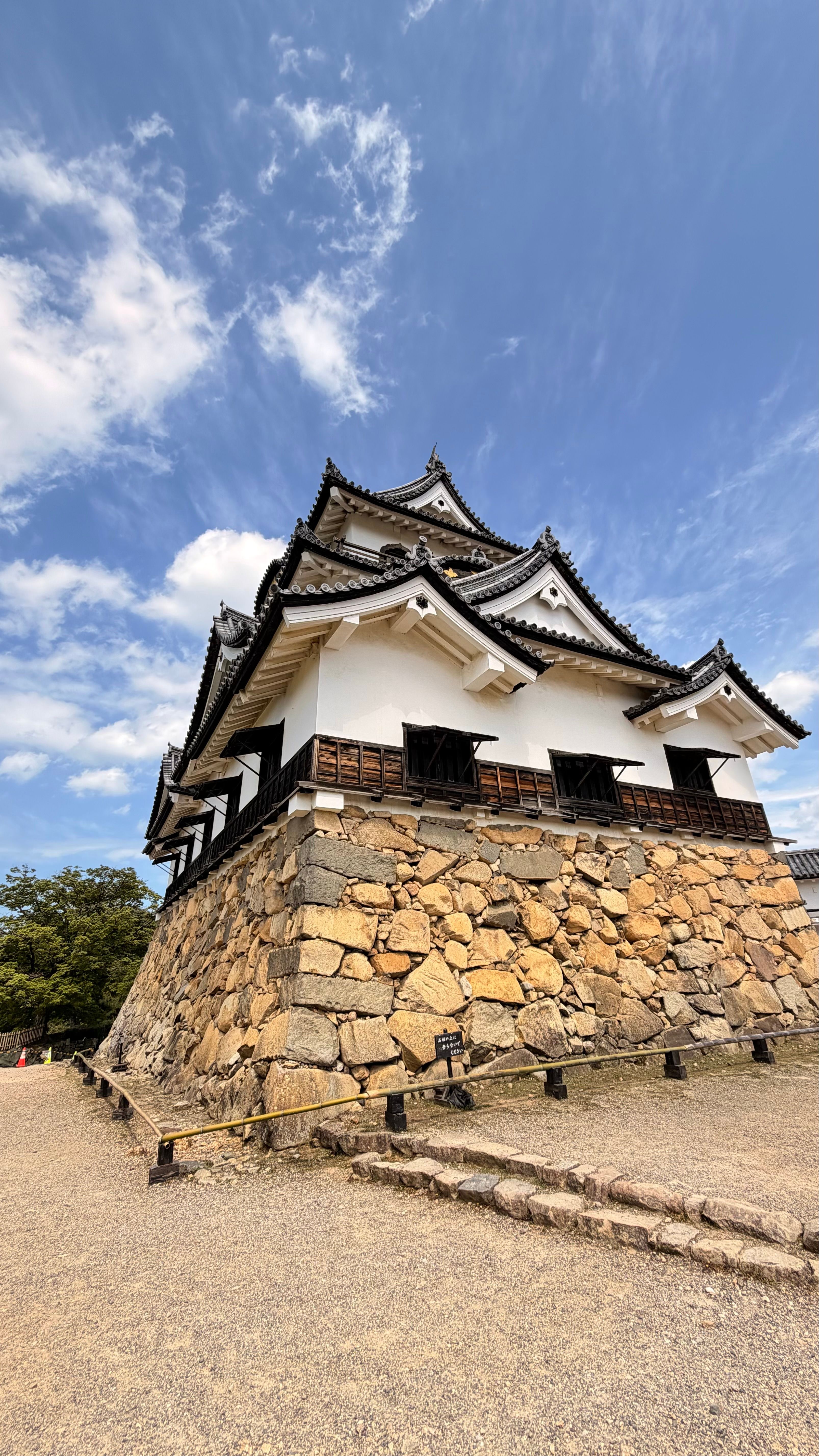
Quick answer: Hikone Castle (彦根城) is one of only twelve Japanese castles that still has its original wooden keep, and one of only five castle keeps in the entire country designated a National Treasure. Built by the powerful Ii clan in the early 1600s on a hill overlooking Lake Biwa, it survives largely intact — no concrete reconstruction here — and sits an easy walk from a JR station, making it one of the most rewarding and least crowded castle day trips from Kyoto or Osaka.
From Sawayama to a New Castle on the Lake
After the pivotal Battle of Sekigahara in 1600, Tokugawa Ieyasu rewarded his trusted general Ii Naomasa — one of the “Four Guardians of the Tokugawa” — with the Sawayama domain in what is now Shiga Prefecture. Naomasa died in 1602 from wounds suffered in battle, before he could act on his reported wish to build a new stronghold of his own. His son and heir, Ii Naokatsu (also recorded under his earlier name, Ii Naotsugu), took up the project on Ieyasu’s direction, choosing a low hill called Konki-yama — soon renamed Hikoneyama — overlooking the shore of Lake Biwa. Construction began around 1603–1604, and the main keep was substantially finished by about 1606–1607. In 1615, after the Siege of Osaka, an ailing Naokatsu ceded leadership of the Hikone domain to his younger half-brother, Ii Naotaka, who had distinguished himself in the fighting; it was under Naotaka that the wider castle complex, including its outer moat and gates, was finally completed in 1622 — roughly two decades after the project began.
A Castle Built From Recycled Castles
Hikone Castle wasn’t built entirely from scratch. To speed up construction and cut costs, the Ii clan dismantled several nearby castles that Ieyasu’s regime no longer needed and reused their materials. The three-story keep itself was largely reconstructed from the components of Otsu Castle’s dismantled tower (originally built in 1575), while the Tenbin Yagura — the distinctive turret named for its “scale” shape, symmetrical on either side of a bridge — was moved wholesale from Nagahama Castle. Stone for the foundations and ramparts came in part from the ruins of Sawayama Castle and Azuchi Castle, Oda Nobunaga’s former stronghold. The practice was common in the period, but Hikone is unusually well documented for it, sometimes earning it an informal nickname along the lines of a “recycled castle.”
One of Only Twelve, One of Only Five
Of the roughly one hundred surviving Japanese castle sites, only twelve still have a keep (tenshu) that dates to the original construction rather than a modern reconstruction — Hikone is one of them. It’s an even smaller group at the top: only five of those original keeps are designated National Treasures by the Japanese government (alongside Himeji, Matsumoto, Inuyama, and Matsue), and Hikone’s keep received that designation in 1952, after being named a National Historic Site the year before. The castle nearly didn’t survive to see any of this. When the Meiji government ordered the demolition of castles across Japan in the 1870s as symbols of the old feudal order, Hikone was reportedly saved only by a direct request from Emperor Meiji during a visit to the region in 1878. It came close to disaster again in 1945: the castle was reportedly on a list of targets scheduled for Allied bombing on August 15 of that year — the same day Japan’s surrender ended the war, sparing it at the last moment.
Hikonyan: The Castle’s Beckoning Cat
Visitors today will almost certainly run into Hikone’s local mascot, Hikonyan — a white cat in a samurai helmet, created in 2007 for the castle’s 400th anniversary. The character draws on a long-standing local legend, not verified history: it’s said that Ii Naotaka, caught in a thunderstorm, was beckoned into the shelter of a temple gate by a white cat and narrowly avoided being struck by lightning that hit the spot he’d just left. Whatever its historical accuracy, the legend (which echoes the older maneki-neko “beckoning cat” tradition) proved wildly popular — Hikonyan now appears for scheduled shows near the castle grounds and remains one of Japan’s best-known regional mascots.

How to Get There
Nearest Shinkansen station: Maibara, on the Tokaido Shinkansen line. Note that the fastest Nozomi trains do not stop here — you’ll need a Hikari or Kodama service.
From Maibara to Hikone Castle: From Maibara Station, transfer to the JR Biwako Line (the local name for this stretch of the JR Tokaido Main Line) for the short, roughly 5-minute ride to Hikone Station. From Hikone Station, it’s about a 15–20 minute walk straight up the main approach road to the castle’s ticket gate; taxis are also available at the station.
From Tokyo: Take the Tokaido Shinkansen (Hikari or Kodama) from Tokyo Station to Maibara, about 2 hours 10–20 minutes, then transfer to the JR Biwako Line to Hikone. Total travel time door-to-gate is roughly 2.5–3 hours, making Hikone a feasible (if long) day trip from Tokyo, or a natural stop if you’re already traveling between Tokyo and Kyoto/Osaka.
From Kyoto: This is the easiest approach. JR “Special Rapid” (Shinkaisoku) trains run directly on the JR Biwako Line from Kyoto Station to Hikone with no transfer, taking about 50 minutes. Alternatively, take the Tokaido Shinkansen to Maibara (about 15–20 minutes) and change to a local train for the final short hop, for a total of around 30–40 minutes — worth it if you have a Japan Rail Pass or are short on time.
From Osaka (Shin-Osaka or Osaka Station): JR Special Rapid trains also run directly through to Hikone via the Biwako Line, taking roughly 1 hour to 1 hour 15 minutes with no transfer. By Shinkansen via Maibara, plan on about 45 minutes to an hour including the connection.
Visiting Tips
- Best seasons: Cherry blossom season (late March–early April), when the castle’s moat and Genkyu-en Garden are framed by hundreds of blooming trees, and autumn (November) for foliage. Both are popular, so arrive early.
- Combine with Genkyu-en Garden: This Edo-period landscape garden sits just below the castle and is included on some combination tickets — a relaxing, less strenuous complement to the climb up to the keep.
- Wear good shoes: Unlike some rebuilt concrete castles, Hikone’s original wooden keep has steep, narrow, and uneven staircases inside — part of its authentic charm, but not ideal in sandals.
- Check for Hikonyan’s schedule: The mascot makes scheduled appearances near the castle several times a day (weather permitting), which can be a fun bonus for families.

FAQ
Is Hikone Castle’s keep a real historical structure, or a modern reconstruction?
It’s genuinely original — one of only twelve castle keeps in Japan that were never destroyed and rebuilt in concrete. Most of Hikone’s keep dates to the early 1600s, incorporating parts salvaged from the even older Otsu Castle.
Can Hikone Castle be visited as a day trip from Kyoto or Osaka?
Yes, easily. It’s about 50 minutes from Kyoto and around an hour to 75 minutes from Osaka by direct JR train, with no transfer required if you take a Special Rapid service. Many visitors combine it with a stop in nearby Nagahama or Omi-Hachiman.
What does “Hikonyan” have to do with the castle?
Hikonyan is Hikone’s official mascot, a white cat in a samurai helmet created in 2007 for the castle’s 400th anniversary. It’s based on a local legend — not confirmed history — about Ii Naotaka being saved from a lightning strike by a beckoning white cat.

Don’t waste your first day in Japan hunting for WiFi
Install it before you board — your eSIM is already connected the second you land.
🏪 No shop visit
💳 No roaming bill shock
2-minute setup · works the moment you land
Leave a Reply