
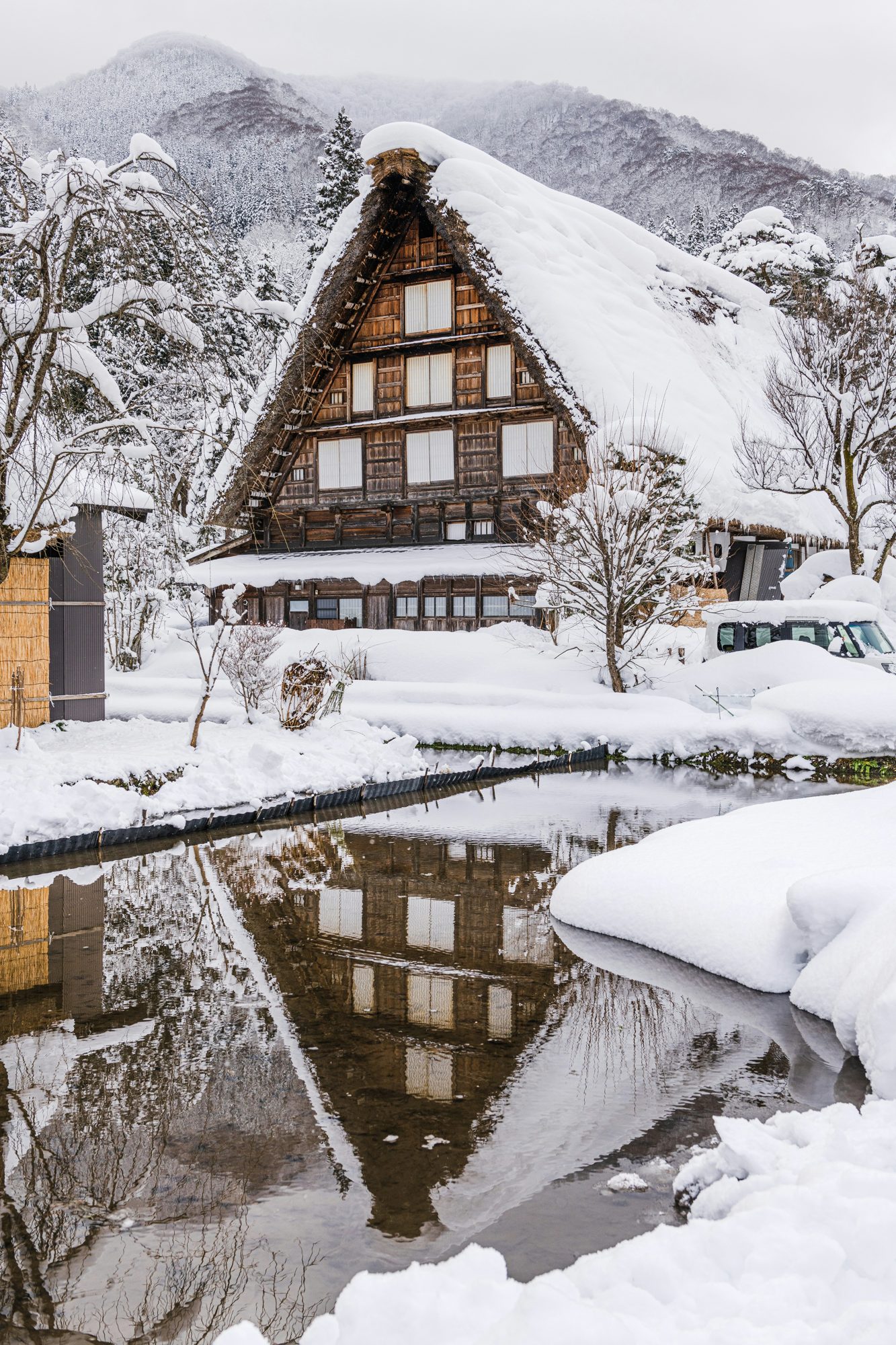
Quick answer: Shirakawa-go is a small mountain village in Gifu Prefecture famous for its gassho-zukuri farmhouses — steep, thatched-roof structures built to shed the region’s heavy snowfall and once used to raise silkworms in their upper floors. Along with the neighboring Gokayama villages in Toyama Prefecture, it became a UNESCO World Heritage Site in 1995, and the Ogimachi hamlet’s photogenic thatched rooftops now draw visitors year-round, especially for the snow-covered scenes of winter.
Roofs Built Like Praying Hands
Gassho-zukuri means “constructed like hands in prayer” — a reference to the way the farmhouses’ steep, triangular thatched roofs resemble two palms pressed together in Buddhist prayer. The design isn’t just decorative: the roofs pitch at roughly 60 degrees so that heavy snow slides off rather than piling up and collapsing the structure, a genuinely practical answer to a region that sits among the snowiest inhabited parts of Japan. The houses are built almost entirely of timber, lashed together with rope rather than nails at key joints so the whole frame can flex under snow load and wind. Many of the surviving houses in Shirakawa-go date back roughly 250 to 300 years, to the mid-to-late Edo period, though the general building style is believed to have developed over many earlier generations.
A Village Built Around Silk
The gassho-zukuri form grew out of necessity as much as climate. Families in this isolated valley made much of their living from sericulture — cultivating mulberry trees and raising silkworms — and needed more indoor space than an ordinary farmhouse could offer. The solution was to build up rather than out: houses with three or four stories, the ground floor for the extended family’s daily life, and the spacious attic levels, lit by the roof’s small windows, used for silkworm cultivation. Heat rising from the ground-floor irori hearth helped keep the worms warm through the valley’s brutal winters. Some of the grandest surviving houses, like the Wada House, belonged to families who grew wealthy from the silk trade during the Edo period.
Isolation, Community, and the Yui Tradition
Hemmed in by steep mountains and, for centuries, lacking easy roads in or out, Shirakawa-go developed in relative isolation from the rest of Japan — a seclusion that let its distinctive architecture, folklore, and social customs persist largely unchanged for generations. One tradition that survives today is yui, a system of mutual aid in which the whole village turns out to rethatch a single house’s roof together in a single coordinated effort, since a gassho roof typically needs full rethatching every 30 to 40 years and the job is far too large for one family alone. Every autumn, the village also holds the Doburoku Festival, offering unrefined doburoku sake to the local mountain deities in thanks for the harvest, with lion dances, taiko drumming, and traditional performances filling the streets.

A UNESCO World Heritage Village
In 1995, Shirakawa-go’s Ogimachi hamlet — home to the largest surviving concentration of gassho-zukuri houses, around 59 of them — was inscribed as a UNESCO World Heritage Site together with the Ainokura and Suganuma hamlets in the neighboring Gokayama district of Toyama Prefecture, under the joint listing “Historic Villages of Shirakawa-go and Gokayama.” The designation recognizes not just the architecture itself but the way of life and social systems that produced and maintained it over centuries of relative isolation.
How to Get There
Shirakawa-go (Ogimachi) sits in a mountain valley in Gifu Prefecture, roughly between Takayama and Kanazawa, and is reached almost entirely by bus rather than train.
From Takayama (closest major hub): Take the Nohi Bus from Takayama Nouhi Bus Center; the ride takes about 50 minutes and costs around ¥2,470 one-way. This is the most common approach for travelers already visiting Takayama.
From Kanazawa: Nohi Bus runs frequent, direct services from Kanazawa Station’s east exit bus terminal; the trip takes about 1 hour 15 minutes and costs around ¥1,850 one-way. Reserving a seat in advance is strongly recommended, especially in peak seasons.
From Nagoya: A direct highway bus departs from the Meitetsu Bus Center, taking about 2 hours 20 minutes (around ¥6,000), with a handful of departures per day.
From Tokyo: The fastest route is the Hokuriku Shinkansen from Tokyo Station to Toyama Station (roughly 2 to 2.5 hours), then a Nohi Bus from Toyama to Shirakawa-go (about 90 minutes). Total travel time is around 3 hours 45 minutes. An alternative, more scenic but slower, is to travel via Nagoya and Takayama by JR Hida limited express, then take the bus from Takayama — figure on 4.5 to 5 hours total for that route.
From Osaka or Kyoto: Take a limited express or the Hokuriku Shinkansen to Kanazawa (roughly 2.5 to 3 hours from Osaka), then the Nohi Bus onward to Shirakawa-go (about 1 hour 15 minutes) — a total journey of around 4 to 4.5 hours.
The bus terminal drops passengers directly in Ogimachi, the village’s main hamlet and the easiest area to explore on foot.
Visiting Tips
- Climb to the Shiroyama viewpoint: A short uphill walk (or shuttle bus) from the village center leads to an observation deck overlooking the entire thatched-roof valley — the classic postcard view of Shirakawa-go.
- Winter light-up events: On select evenings in January and February, the village illuminates its snow-covered rooftops after dark. These nights require advance reservations and draw large crowds, so check the schedule and book early if this is your goal.
- Arrive early: Shirakawa-go is a popular day-trip stop on tour bus routes; arriving in the morning, especially on weekdays, means a quieter walk through the hamlet.
- Stay overnight if you can: Several gassho-zukuri houses operate as minshuku (family-run guesthouses), letting you experience the village after the day-trippers leave.

FAQ
Is Shirakawa-go a living village or an open-air museum?
It’s a real, inhabited village — many of the gassho-zukuri houses are still private homes, working minshuku, or small shops, not museum exhibits.
Can I go inside a gassho-zukuri house?
Yes. Several houses, including the Wada House, are open to the public as museums showing the traditional multi-story interior and silk-farming attic space.
What’s the best time of year to visit?
Winter (especially the light-up dates in January–February) is the most iconic for snow scenery, while spring’s fresh green and autumn’s foliage are quieter, easier-to-plan alternatives.
Getting There
Nearest station: None directly — Ogimachi has no train station and is reached by highway bus.
From Takayama Station, Nohi Bus runs an express bus to the Shirakawa-go Bus Terminal (about 50 minutes, ¥2,470). From Kanazawa Station’s east exit, the same operator runs buses roughly every hour (about 75–85 minutes, ¥1,850). Either way, the bus terminal drops you within a few minutes’ walk of the Ogimachi village.

Don’t waste your first day in Japan hunting for WiFi
Install it before you board — your eSIM is already connected the second you land.
🏪 No shop visit
💳 No roaming bill shock
2-minute setup · works the moment you land
Leave a Reply