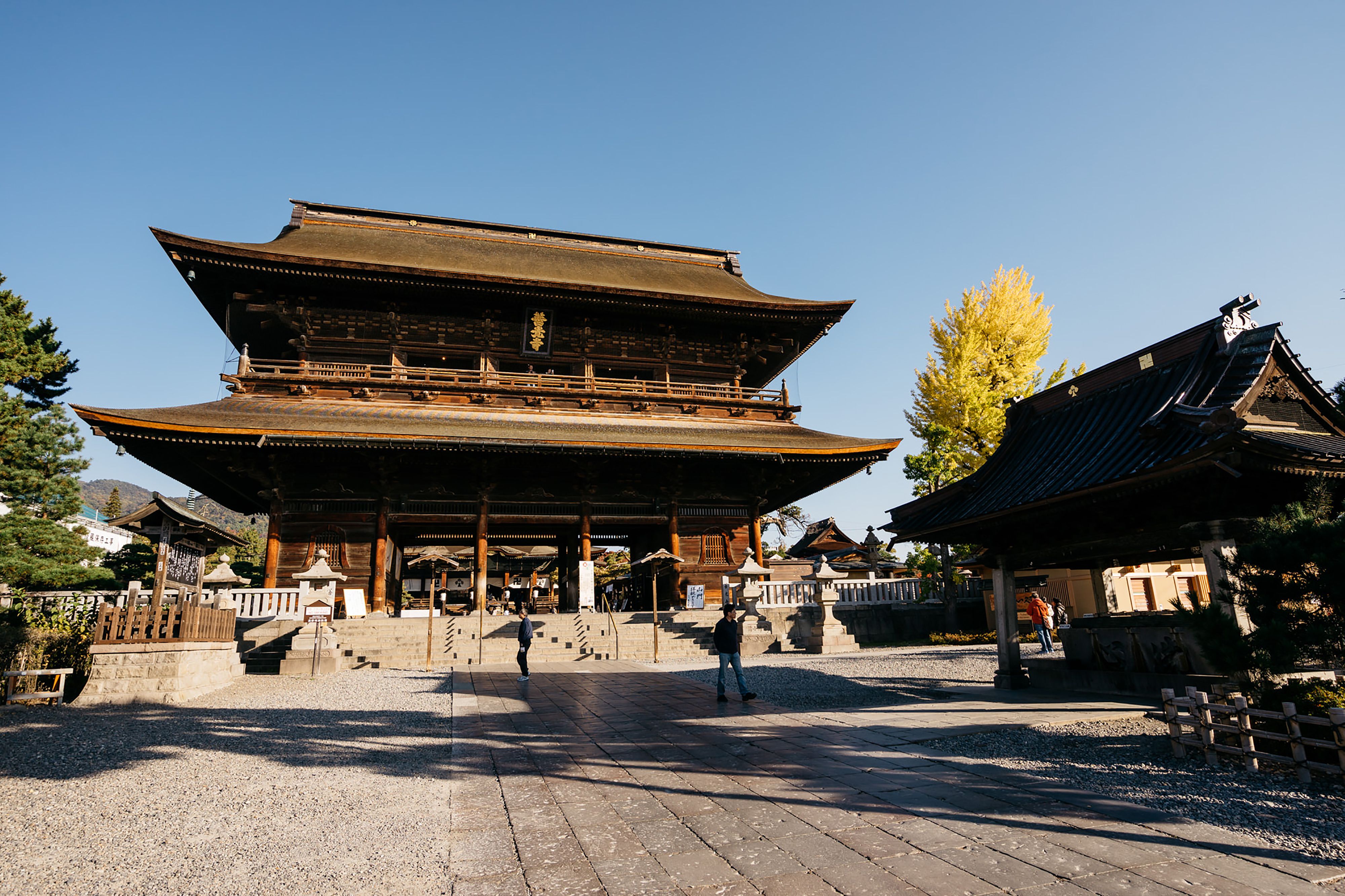

Quick answer: Zenkoji was founded roughly 1,400 years ago, before Japanese Buddhism had split into the various sects that exist today (Zen, Jodo, Shingon, and so on) — which is exactly why it remains officially non-denominational, open to worshippers of any Buddhist tradition or none at all. Its principal image, said to be the very first Buddhist statue ever brought to Japan, has never been shown publicly; a stand-in statue is unveiled only once every seven years, drawing millions of pilgrims each time.
A Statue Older Than Japanese Buddhism Itself
According to temple tradition, the story begins with the Ikko Sanzon Amida Nyorai — three Amida Buddha figures gathered under a single halo — which arrived in Japan from the Korean kingdom of Baekje in 552, the same year Buddhism was officially introduced to the Japanese imperial court. It’s said to be the oldest Buddhist statue in the country. Legend holds that the statue became caught up in a political and religious conflict between the pro-Buddhist Soga clan and the anti-Buddhist Mononobe clan, and was thrown into a canal in Naniwa (present-day Osaka). A man named Honda Yoshimitsu, from Shinano Province, is said to have discovered it there and carried it home, eventually enshrining it in what would become Zenkoji — a temple whose very name derives from an alternate reading of his own.
It’s worth noting this founding story is legend rather than verified history, though the temple’s roughly 1,400-year age and its uniquely early, pre-sectarian origins are well documented.
Older Than the Sects That Divide Japanese Buddhism
What makes Zenkoji genuinely unusual isn’t just its age, but its position in Buddhist history: it was founded before Japanese Buddhism organized into the distinct schools — Tendai, Shingon, Jodo, Zen, and others — that would come to define most other major temples. Because Zenkoji predates that split, it never aligned itself with a single sect, and to this day remains an independent, non-denominational (mushuha) temple. In practice, it’s jointly managed by clergy from both the Tendai and Jodo-shu traditions, but it belongs fully to neither. This openness — welcoming visitors regardless of sect, gender, or background — helped make it one of the most broadly visited pilgrimage sites in the country. A well-known Edo-period saying captured its reputation: “You should visit Zenkoji at least once in your life.”

The Buddha No One Is Allowed to See
Zenkoji’s principal image has been treated as an absolute hidden Buddha (zettai hibutsu) for its entire history — meaning it has never been displayed publicly, not even to the temple’s own priests. In its place, a substitute statue called the Maedachi Honzon stands in for it during regular worship. Even this stand-in is unveiled to the public only once every seven years, during a festival called Gokaicho, which regularly draws several million visitors to Nagano over the several weeks it runs.
Touching the “Key to Paradise” in Total Darkness
One of Zenkoji’s most distinctive rituals is the Okaidan-meguri, or “circuit of the precepts.” Visitors descend into a completely unlit passage beneath the main altar, roughly 45 meters long, and feel their way along the wall in pitch blackness until they locate a metal fixture known as the “Key to Paradise” (gokuraku no jomae), positioned directly beneath the hidden principal image above. Touching it is said to form a karmic connection with Amida Buddha and a promise of rebirth in the Pure Land. According to temple tradition, an eternal flame (jotomyo) has also burned continuously within the temple for some 1,400 years, since the time of its founding.
Visited By Shoguns, Open to Everyone
Across the centuries, Zenkoji drew worship and patronage from major historical figures, including the shogun Minamoto no Yoritomo and the Tokugawa shoguns, alongside ordinary pilgrims from every social class. Its main hall (Hondo), a National Treasure and one of the largest wooden structures in Japan, has burned down and been rebuilt several times over its long history; the current hall dates to 1707.
How to Get There
Zenkoji is located in Nagano City, Nagano Prefecture.
- From Tokyo: Take the Hokuriku Shinkansen from Tokyo Station directly to Nagano Station, about 1 hour 20 minutes to 1 hour 30 minutes on the fastest “Kagayaki” trains.
- From Osaka/Kyoto: There’s no single direct line; the most practical route is the Tokaido Shinkansen to Tokyo, then a transfer to the Hokuriku Shinkansen to Nagano (roughly 4 hours total), or a JR limited express connection via Nagoya/Shinano services, or a long-distance highway bus.
- From Nagano Station to the temple:
- Bus: From the Zenkoji Exit bus terminal, platform 1, take any bus (all buses from this platform head toward Zenkoji) to the “Zenkoji-Daimon” stop, about 15 minutes, ¥190, with departures roughly every 15 minutes.
- Walk: About 25–30 minutes straight up the temple’s traditional approach road (Chuo-dori) from the station — a popular way to arrive, since the street itself is lined with traditional shops.
Visiting Tips
- Try the Okaidan-meguri underground passage — it’s included with a standard inner sanctum ticket and only takes a few minutes, but it’s genuinely pitch dark.
- Check whether your visit coincides with the next Gokaicho unveiling (held roughly once every seven years) if you want to see the stand-in image; otherwise the temple and its rituals are open to visit year-round.
- Walk the full approach from Nagano Station along Chuo-dori at least one direction, rather than only taking the bus, to experience the traditional pilgrim’s route into the temple.
Getting There
Nearest station: JR Nagano Station.
It’s about a 30-minute walk straight up Chuo-dori from the station to the temple. Most visitors instead take a bus bound for Zenkoji from Bus Stop #1 at the Zenkoji Exit to the Daimon stop (about 15 minutes, ¥190), then walk the remaining 8 minutes, or ride the Nagaden underground line to Zenkojishita Station (4 minutes, ¥170) for a 5–10 minute walk.
FAQ
- Can visitors see the actual principal Buddha statue? No — it’s an “absolute hidden Buddha” never shown publicly, not even to temple priests. A substitute statue, the Maedachi Honzon, is unveiled to the public only once every seven years.
- Why doesn’t Zenkoji belong to a specific Buddhist sect? It was founded before Japanese Buddhism split into organized sects like Zen, Shingon, or Jodo, so it never aligned with one; it remains independently run today, jointly overseen by Tendai and Jodo-shu clergy.
- What is the Okaidan-meguri? A ritual walk through a completely dark underground corridor beneath the main hall, where visitors feel along the wall to find a “Key to Paradise” believed to connect them spiritually with the hidden principal Buddha directly above.

Don’t waste your first day in Japan hunting for WiFi
Install it before you board — your eSIM is already connected the second you land.
🏪 No shop visit
💳 No roaming bill shock
2-minute setup · works the moment you land
Leave a Reply