
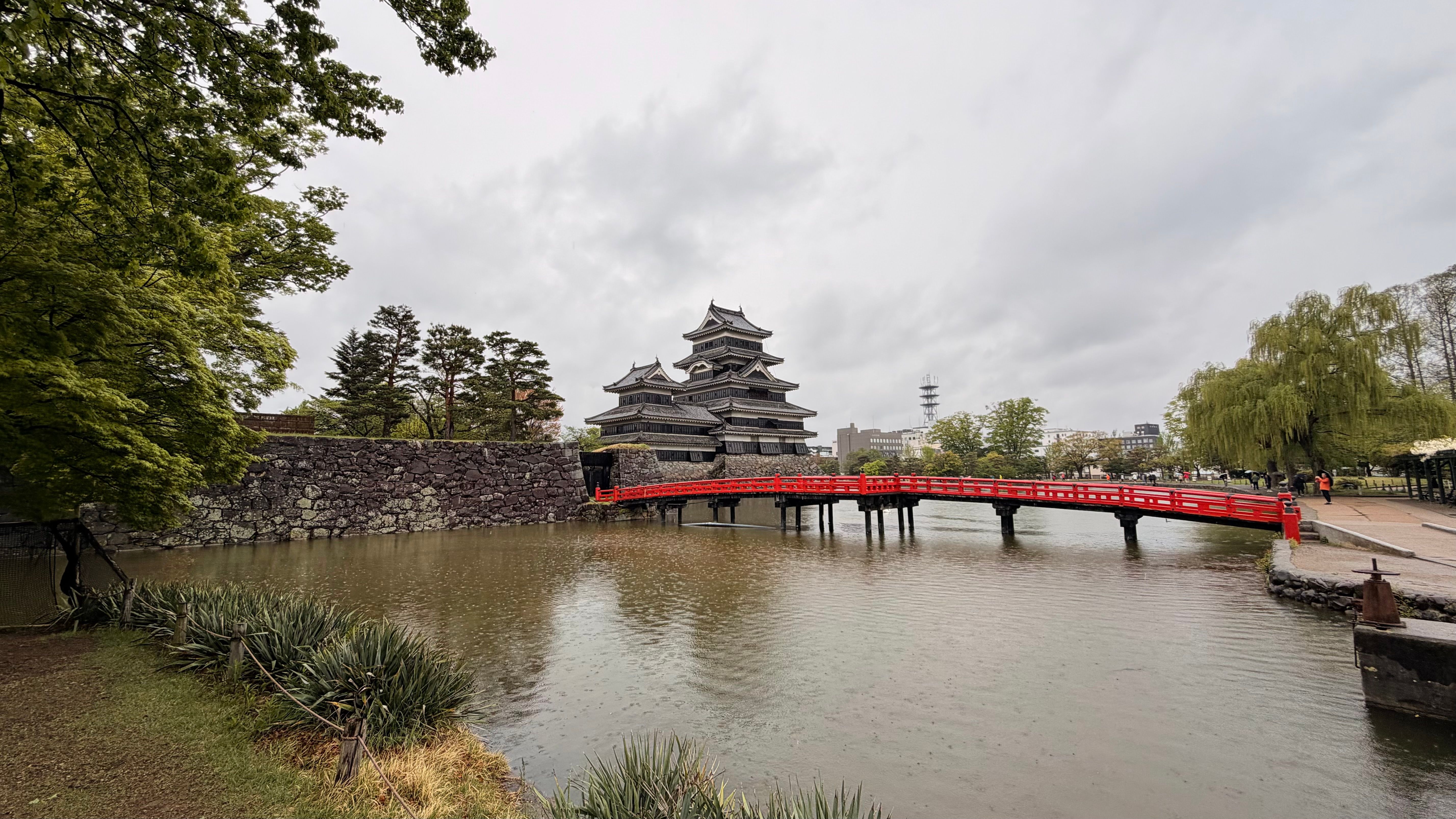

Quick answer: Matsumoto Castle’s black, five-story main keep was built around 1593–1594 by Ishikawa Kazumasa and his son Yasunaga, on the site of an earlier fort called Fukashi Castle. It’s one of only two five-story original castle keeps left in Japan (alongside Himeji), one of just twelve castles nationwide with a surviving original keep, and one of only five castles whose keep is a National Treasure — making it one of the most historically intact castles anywhere in the country.
From Fukashi Castle to the Ishikawa Rebuild
Long before the black castle tourists photograph today, a smaller fortification called Fukashi Castle stood on this site, built in the early 1500s during the Sengoku period as a base for the Ogasawara clan and their retainers. Control of the region shifted repeatedly amid the era’s constant warfare — the warlord Takeda Shingen took the area in 1550, and the Ogasawara clan reclaimed it after the Takeda’s fall in 1582.
The decisive transformation came after Toyotomi Hideyoshi’s 1590 conquest of the Hojo clan at Odawara. Ishikawa Kazumasa, a former Tokugawa retainer who had defected to Hideyoshi’s side, was installed as lord of the region and renamed the castle Matsumoto. Kazumasa and his son Yasunaga spent the following years rebuilding it into a proper castle and castle town, and around 1593–1594 completed the five-story, six-floor main keep that still stands today. Together, father and son ruled Matsumoto for 23 years.

A Rare Survivor: One of Twelve Original Keeps
Of the roughly hundreds of castles built across Japan during the feudal era, only twelve retain their original main keep rather than a modern concrete reconstruction — and Matsumoto Castle is one of them. Its keep, connecting turret, and smaller keep, all built during the Ishikawa era, together with two additional structures added later, form a complex of five buildings that are collectively designated National Treasures — a status shared by only five castles in all of Japan.
Matsumoto’s five-story design is itself unusual: among Japan’s surviving original castles, only Matsumoto and Himeji reach five stories, making them structurally the two grandest of the group. Unlike Himeji or most other hilltop castles, Matsumoto was built on flat ground (a style called hirajiro), its black form reflected dramatically in the surrounding moat, with the Northern Japan Alps rising in the distance.
A Peacetime Addition: The Moon-Viewing Turret
Not every part of the castle was built for war. In the mid-1630s, decades after Japan had settled into the peace of the Edo period, castle lord Matsudaira Naomasa added the Tsukimi-yagura, or Moon-Viewing Turret, on the keep’s southeast side. With open sides and vivid vermillion-lacquered railings designed purely for enjoying the moon and hosting gatherings, it has no defensive function whatsoever — a rare architectural symbol of the shift from a fortress built for war to a residence built for peace.
Why “Crow Castle”?
Matsumoto Castle is popularly nicknamed Karasu-jo, or “Crow Castle,” after the black-lacquered wooden boards covering the lower portions of its exterior walls — a striking contrast to the white-walled “Shirasagi-jo” (White Heron Castle) nickname associated with Himeji. Interestingly, the castle’s own management office notes that no historical documents have actually been found using “Karasu-jo” as a period name for the castle, meaning it’s best understood as a popular, modern-day nickname rather than a name with documented Edo-period origins.
Visiting Today
Visitors can climb the original wooden staircases inside the keep — steep and narrow by modern standards, a genuine glimpse of 16th-century castle construction rather than a reconstructed museum interior. The surrounding park and moat are popular for cherry blossoms in spring and for the striking contrast of black castle against snow in winter.

How to Get There
Matsumoto Castle is located in Matsumoto City, Nagano Prefecture.
- From Tokyo: Take the JR Chuo Line limited express “Azusa” directly from Shinjuku Station to Matsumoto Station, about 2 hours 30 minutes. Alternatively, take the Hokuriku Shinkansen from Tokyo Station to Nagano, then transfer to the limited express “Shinano” to Matsumoto (roughly 2 hours total). A highway bus from Shinjuku is also available, around 3 hours 15 minutes.
- From Osaka/Kyoto: Take the Tokaido Shinkansen to Nagoya (about 50 minutes from Shin-Osaka), then transfer to the limited express “Shinano” to Matsumoto, about 2 hours — roughly 3 hours total.
- From Matsumoto Station to the castle:
- Walk: About 15–20 minutes (roughly 1–1.5km north of the station), passing through shopping streets.
- Bus: The “Town Sneaker” loop bus, about 6 minutes, ¥200 per ride (¥500 all-day pass).
- Taxi: About 5 minutes.
Visiting Tips
- Climb to the top floor of the keep if mobility allows — the staircases are steep, but the view from the top is worth it.
- Cherry blossom season (early-to-mid April) and winter snow are the two most photogenic times to visit, given the black-and-white/black-and-red contrast of the architecture.
- Buy tickets in advance during peak seasons (spring and autumn), as entry to the keep can involve long queues due to the narrow original staircases limiting visitor flow.
Getting There
Nearest station: JR Matsumoto Station.
The castle is about a 15-minute walk from the station. If you’d rather not walk, the Town Sneaker bus’s North Course covers the distance in about 10 minutes from the Oshiroguchi stop.
FAQ
- Is Matsumoto Castle’s keep an original building or a reconstruction? It’s original — the main keep dates to around 1593–1594 and is one of only twelve castle keeps in Japan that were never destroyed and rebuilt.
- Why is it called “Crow Castle”? Because of its black-lacquered exterior walls, in contrast to white-walled castles like Himeji. However, castle authorities note this nickname isn’t confirmed in historical Edo-period documents, so it’s best treated as a popular modern nickname.
- How is Matsumoto different from other National Treasure castles? It’s one of only two surviving five-story original keeps (with Himeji) and one of only five castles nationwide whose keep holds National Treasure status, making it structurally and historically among the most significant castles in Japan.

Don’t waste your first day in Japan hunting for WiFi
Install it before you board — your eSIM is already connected the second you land.
🏪 No shop visit
💳 No roaming bill shock
2-minute setup · works the moment you land
Leave a Reply