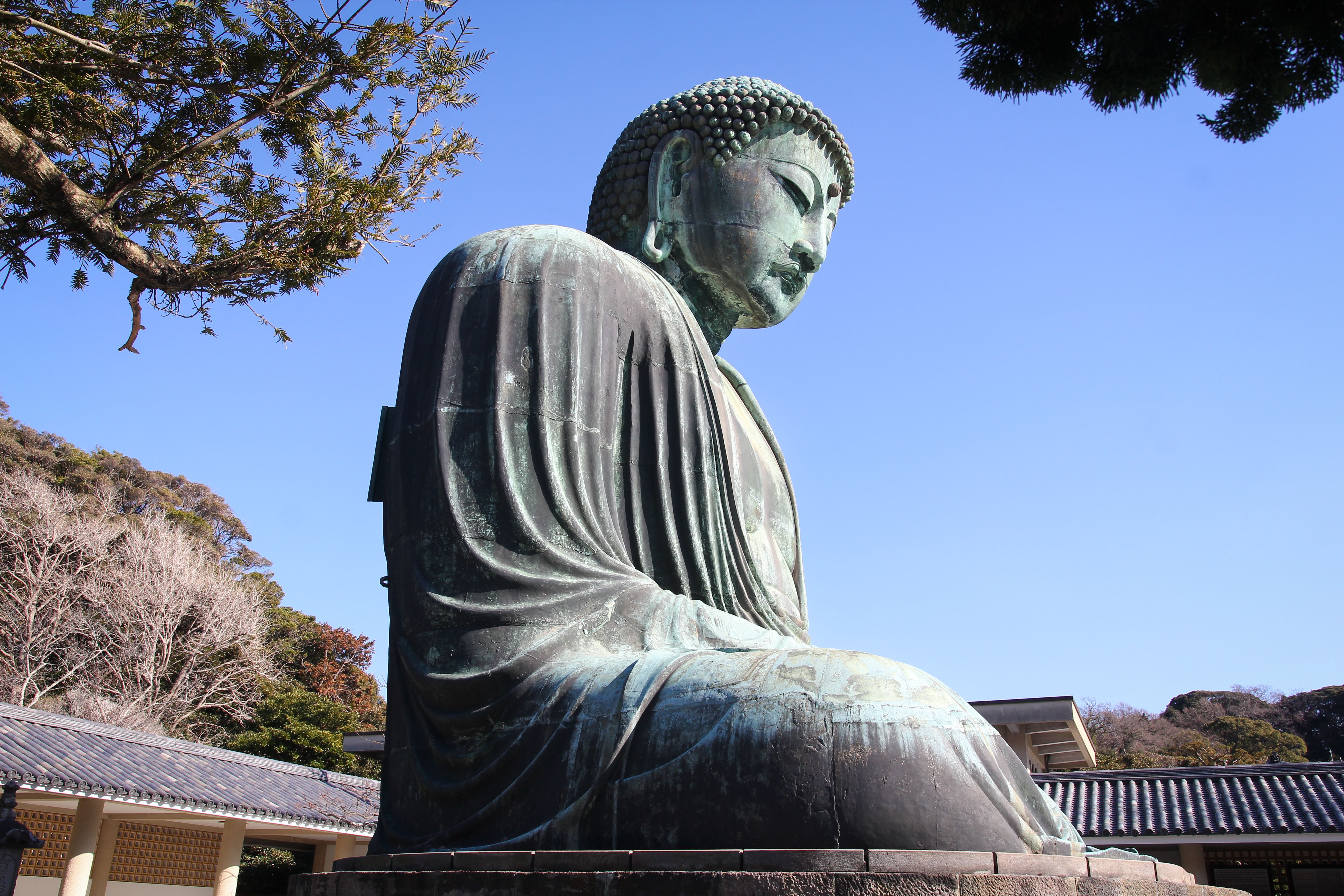
Quick answer: Kamakura, a short train ride from Tokyo, was Japan’s political capital during the Kamakura shogunate (1185–1333) and preserves two of its most iconic landmarks: the Great Buddha (Kamakura Daibutsu), a 13th-century bronze statue that has sat in the open air for over 500 years, and Tsurugaoka Hachimangu, the shrine founded by shogun Minamoto no Yoritomo as the spiritual heart of his new samurai government. Both sites are easily combined in a single day trip from Tokyo, Yokohama, or even Osaka.
Founding of Tsurugaoka Hachimangu and the Rise of Kamakura
Tsurugaoka Hachimangu’s story begins in 1063, when the samurai commander Minamoto no Yoriyoshi invited a divided spirit of Iwashimizu Hachimangu (near Kyoto) to Yui, on the shore near present-day Kamakura, establishing a shrine to the Minamoto clan’s guardian deity, the war god Hachiman. That original shrine survives today as a small satellite site known as Moto Hachiman (“original Hachiman”).
Everything changed in 1180, when Minamoto no Yoritomo — soon to become Japan’s first shogun — made Kamakura his base of operations and relocated the shrine to its present site at the foot of a hill. Over the following years he built up the surrounding city as the seat of his new warrior government: in 1182 he laid out the grand approach road Wakamiya Oji with its raised central path, the Dankazura, and had the Genpei-ike ponds dug in front of the shrine. After a fire destroyed the shrine buildings in 1191, Yoritomo rebuilt it on a larger scale, with the main hall (Hongu) set on the hillside above — essentially the layout still seen today. Tsurugaoka Hachimangu became the tutelary shrine not just of the Minamoto clan but of the entire samurai class that Kamakura came to represent.
Casting the Great Buddha
The Great Buddha has a separate and later origin. In 1238, a Buddhist monk named Joko raised funds nationwide to build a large wooden statue of Amida Buddha at what is now Kotoku-in temple. That wooden version didn’t last — the bronze statue familiar to visitors today began casting in 1252, and by 1264 it was confirmed complete (a temple bell inscription from that year names the caster, Tanji Hisatomo). Standing about 11.3 meters tall and weighing roughly 121 tons, it remains one of the largest bronze Buddha statues in Japan and was designated a National Treasure in 1958. Visitors can pay a small additional fee to step inside the hollow bronze interior.
Open to the Sky: Why the Buddha Has No Hall
Unlike most major Buddhist statues in Japan, the Kamakura Daibutsu sits outdoors, without a surrounding hall — and that wasn’t the original plan. The bronze Buddha was originally housed inside a large wooden hall, but records show the structure collapsed more than once from storms, including a major windstorm in 1369. Some accounts also point to the tsunami generated by the 1498 Meio-era earthquake as a final blow, though historians today debate the exact sequence of events; what’s clear is that by the late 15th century the hall was gone and never rebuilt, leaving the Buddha in the open air it has occupied ever since. One historical footnote worth knowing: despite what many travel guides assume, neither the Great Buddha nor Tsurugaoka Hachimangu is a UNESCO World Heritage Site. Kamakura’s “Samurai Capital” bid was formally reviewed by UNESCO’s advisory body in 2013 and received a rare non-inscription recommendation, after which Japan withdrew the nomination.
Legend and Loss: The Hidden Gingko
Just inside Tsurugaoka Hachimangu’s stone steps once stood a massive gingko tree, popularly called the “hiding gingko” (kakure-icho). According to a long-told legend, the monk Kugyo hid behind this tree before assassinating his uncle, the third shogun Minamoto no Sanetomo, on the steps in 1219 — though modern historians note that gingko trees weren’t yet common in Japan at that time, so the story is best treated as legend rather than confirmed fact. The centuries-old tree itself blew over in a storm on March 10, 2010; a shoot regrown from its surviving roots has since grown to over eight meters tall near the original spot.

How to Get There
From Tokyo: Take the JR Yokosuka Line directly from Tokyo Station to Kamakura Station (about 1 hour), or the JR Shonan-Shinjuku Line from Shinjuku or Shibuya (about 55 minutes).
From Kamakura Station to Tsurugaoka Hachimangu: It’s about a 10-minute walk north up Wakamiya Oji or the parallel shopping street Komachi-dori.
From Kamakura Station to the Great Buddha: Take the Enoshima Electric Railway (Enoden) three stops to Hase Station (about 5 minutes), then walk roughly 7 minutes; alternatively, take a bus from Kamakura Station’s East Exit (platform 1 or 6) to the “Daibutsu-mae” stop.
Between the two sites: They’re roughly a 30–40 minute walk apart, or can be connected via a short bus/Enoden-plus-walk combination — most visitors see Hachimangu and the Buddha as two stops on the same day.
From Osaka or Kyoto: Take the Tokaido Shinkansen to Tokyo Station (about 2.5–3 hours), then transfer to the JR Yokosuka Line to Kamakura (about 1 hour more).

Visiting Tips
- Go early: Komachi-dori and the approach to the Great Buddha get crowded by mid-morning, especially on weekends.
- Get a one-day Enoden pass (“Noriorikun”) if you’re visiting the Buddha, since the Enoden line also serves other Kamakura sights.
- Best seasons: Early April for cherry blossoms along the Dankazura approach, and November for autumn foliage around Genpei-ike ponds.
- Bring small change if you want to see inside the Great Buddha’s hollow interior — it’s a separate, modest fee at the entrance.
FAQ
Is the Great Buddha a UNESCO World Heritage Site?
No. Kamakura’s bid for World Heritage status was reviewed and not recommended for inscription in 2013, and Japan withdrew the nomination that year.
Can you go inside the Great Buddha?
Yes — for a small additional fee, visitors can enter the hollow bronze interior and see how the statue was cast in sections.
Are the Great Buddha and Tsurugaoka Hachimangu historically connected?
Not directly — they were founded independently, decades apart (Hachimangu in the 1060s/1180s, the Buddha from 1238–1252) — but both are defining landmarks of Kamakura-period Japan and sit close enough together to visit in one trip.
Getting There
Nearest station: Hase Station (Enoshima Electric Railway, “Enoden”)
From Kamakura Station, take the Enoshima Electric Railway three stops to Hase Station, then walk about 7 minutes to Kotoku-in and the Great Buddha. Walking the whole way from Kamakura Station takes roughly 30 minutes.

Don’t waste your first day in Japan hunting for WiFi
Install it before you board — your eSIM is already connected the second you land.
🏪 No shop visit
💳 No roaming bill shock
2-minute setup · works the moment you land
Leave a Reply