
Quick answer: Tokyo’s Imperial Palace sits on the site of Edo Castle, the former seat of the Tokugawa shogunate that ruled Japan for over 260 years. First fortified in 1457 and massively expanded by Tokugawa Ieyasu from 1590, the castle became the imperial residence after the Meiji Restoration of 1868. Most of the wooden castle is gone, but moats, stone walls, and several gates survive, and the surrounding East Gardens are open to the public free of charge most days.
Ota Dokan’s Fort on the Kojimachi Plateau (1457)
The site’s fortified history begins well before the Tokugawa era. In 1457, the samurai commander Ota Dokan built a castle on the eastern edge of the Kojimachi plateau, at what was then a minor settlement called Edo. Dokan’s fortress was modest by later standards, but it established the strategic value of the location — elevated ground near the mouth of several rivers flowing into Tokyo Bay — that would later make it the natural choice for a much larger seat of power.
Tokugawa Ieyasu Builds the Most Powerful Fortress in Japan (from 1590)
Everything changed in 1590, when Tokugawa Ieyasu, newly granted the Kanto region, made Edo his headquarters. Ieyasu mobilized daimyo (feudal lords) from across the country to contribute stone, labor, and materials, transforming the modest existing fort into what became the largest and most powerful castle complex in Japan. By the time Ieyasu was formally appointed shogun in 1603 — beginning the Edo period — the castle’s outer walls already enclosed an area of roughly 70 hectares. Construction and expansion continued for decades under his successors, and by the time of the third shogun, Tokugawa Iemitsu, Edo Castle had become the administrative and military center of the entire country, a role it held for more than 260 years.

From Shogun’s Castle to Imperial Palace (1868)
The Tokugawa shogunate fell in the Meiji Restoration of 1868, and Edo was renamed Tokyo — “eastern capital” — as the seat of the newly restored imperial government. Edo Castle itself became the residence of the Emperor and was renamed the Imperial Palace (Kokyo). Much of the castle’s wooden architecture was lost over the following decades to fire, demolition, and the 1945 air raids of WWII, and the current Imperial Palace main buildings, including the Kyuden state rooms, were completed in 1968.
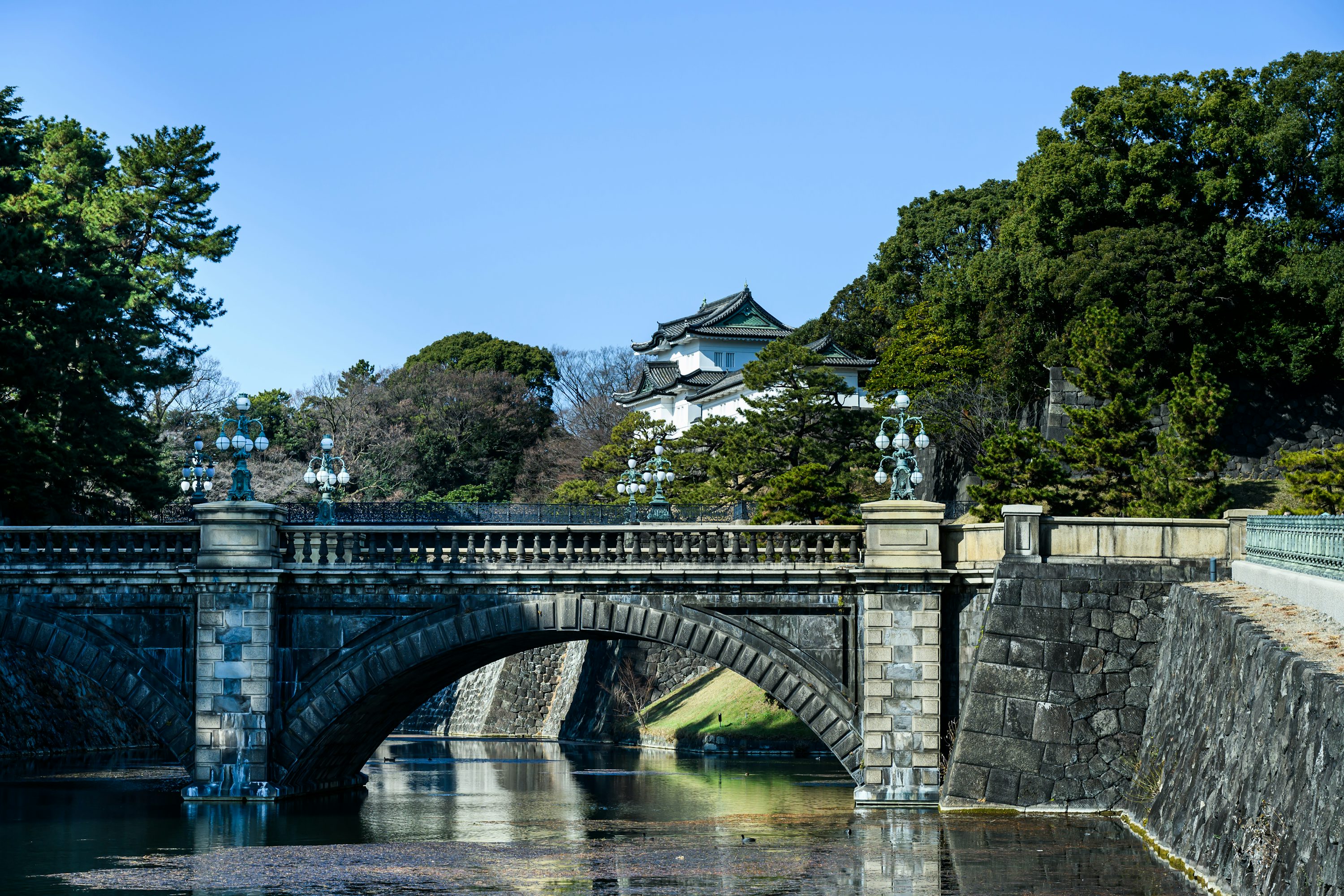
What remains today from the Edo Castle era are largely the bones of the fortress rather than its buildings: extensive moats and stone walls, several surviving gates including Tayasumon and Shimizumon (both Important Cultural Properties), the Sakuradamon outer gate, and structures such as the Fujimi Yagura watchtower, one of the few original castle turrets still standing. The site as a whole is designated a Special Historic Site as “the ruins of Edo Castle.”
How to Get There
The Imperial Palace sits in Chiyoda Ward, right in the heart of central Tokyo, immediately west of Tokyo Station.
- Tokyo Station (Marunouchi side) — about a 7-minute walk to the palace plaza and the famous Nijubashi bridge viewpoint.
- Otemachi Station (served by five subway lines) — a direct route to Otemon, the main gate into the East Gardens.
- Takebashi Station (Tokyo Metro Tozai Line) — close to the Kitanomaru Park side and another East Gardens entrance.
- Nijubashimae “Marunouchi” Station (Chiyoda Line) and Sakuradamon Station (Yurakucho Line) — both within a few minutes’ walk of the palace plaza.
| From | Route | Approx. time |
|---|---|---|
| Tokyo Station | Walk from the Marunouchi central exit | ~7–10 min |
| Narita Airport | Narita Express (N’EX) direct to Tokyo Station | ~55–90 min |
| Haneda Airport | Tokyo Monorail to Hamamatsucho + JR to Tokyo Station | ~30–40 min |
| Osaka / Kyoto | Tokaido Shinkansen direct to Tokyo Station | ~2.25–2.5 hours |
Tokyo Station is one of the most convenient palace access points in the city, since both the Narita Express and the Tokaido Shinkansen terminate there directly — no further transfer needed before the short walk to the palace grounds.
Visiting Tips
- The Imperial Palace’s inner grounds are not freely open to the public year-round. They’re open to visitors on just two days a year — January 2 (New Year’s Greeting) and February 23 (the current Emperor’s Birthday) — or via a free guided tour arranged in advance through the Imperial Household Agency (offered most weekdays except Monday and Friday afternoons).
- The East Gardens (Kokyo Higashi Gyoen), covering the former Honmaru and Ninomaru areas of Edo Castle, are open to the public free of charge most days (closed Mondays, Fridays, and other set dates) — this is where most visitors actually get to walk among the historic stone foundations.
- The best-known photo spot, the Nijubashi (“Double Bridge”) area, is viewable year-round from the outer plaza (Kokyo Gaien) without needing to enter the grounds at all.
- Spring (cherry blossoms along the moat) and autumn foliage are the most popular — and most crowded — seasons to visit.
Getting There
Nearest station: Tokyo Station (Marunouchi side) or Nijubashimae Station
From Tokyo Station’s Marunouchi Central Exit, it’s about a 10-minute walk to the Imperial Palace grounds. Alternatively, Tokyo Metro’s Nijubashimae Station (Chiyoda Line) or Otemachi Station put you within a 5–15 minute walk of the palace’s various gates, including Nijubashi Bridge.
FAQ
- Can visitors go inside the Imperial Palace? The inner palace grounds are only open on January 2 and February 23 each year, or via a free advance-reservation guided tour. The East Gardens, on the former castle’s inner citadel, are open most other days without reservation.
- Is any of the original Edo Castle still standing? Most of the wooden castle architecture is gone, but substantial stone walls, moats, several historic gates (including Tayasumon and Shimizumon), and the Fujimi Yagura watchtower survive from the Edo period.
- What’s the difference between the “Imperial Palace” and “Edo Castle”? They’re the same physical site at different points in history. Edo Castle was the name and function of the complex under the Tokugawa shogunate (1603–1868); after the Meiji Restoration, it became the Emperor’s residence and was renamed the Imperial Palace.

Don’t waste your first day in Japan hunting for WiFi
Install it before you board — your eSIM is already connected the second you land.
🏪 No shop visit
💳 No roaming bill shock
2-minute setup · works the moment you land
Leave a Reply