
Quick answer: Senso-ji traces its origin to the year 628, when two fishermen brothers are said to have pulled a small golden statue of the bodhisattva Kannon from the Sumida River. A temple was built to enshrine it, and by 645 it was formally established — making Senso-ji Tokyo’s oldest temple. Today it’s known for the giant red lantern at Kaminarimon (“Thunder Gate”), the Nakamise shopping street, and a five-story pagoda, all rebuilt more than once after fire, war, and earthquake.
The Legend of the Golden Kannon (628 CE)
According to temple tradition, on the morning of March 18, 628, two brothers, Hinokuma Hamanari and Hinokuma Takenari, were fishing in the Sumida River when their net brought up a small golden statue of Kannon, the bodhisattva of mercy. The story goes that each time they returned the statue to the river, it found its way back into their net. When they showed it to the village chief, Haji no Nakatomo, a devout Buddhist, he recognized its significance, remodeled his own house into a small temple, and dedicated his life to Kannon worship. This is passed down as legend rather than verified history, but it remains the founding story every visitor to Senso-ji hears.
From Village Shrine to Tokyo’s Oldest Temple (645 CE)
The temple that grew from that shrine was formally established in 645, when, according to tradition, the priest Shokai Shonin built the main hall and, following a divine revelation, decided the statue would never again be shown to the public — a practice of concealment that continues today. This makes Senso-ji, by a wide margin, the oldest temple in what is now Tokyo, predating the city itself by over a millennium.
The original statue has been hidden from public view since that decision in the 7th century. In 857, the priest Ennin carved a substitute image, which is displayed to worshippers just once a year, on December 13.
Kaminarimon: Burned, Lost for Nearly a Century, and Rebuilt by a Panasonic Founder

The Kaminarimon gate, with its 700-kilogram red lantern, is Senso-ji’s most photographed symbol, but the gate standing today is relatively young. The gate burned down repeatedly over the centuries and was completely destroyed by fire in 1865. It then sat unrebuilt for nearly a century.
In 1960, Matsushita Konosuke — founder of what is now Panasonic — funded the gate’s reconstruction in reinforced concrete. According to the often-told story, Matsushita had prayed at Senso-ji during a bout of illness and recovered, and rebuilt the gate out of gratitude, reportedly asking that his name not be publicized. The current lantern and gate are refurbished roughly once a decade; Panasonic donated a newly rebuilt lantern again in 2020.
Rebuilt Again After WWII
Senso-ji’s main hall, once a nationally designated treasure, was destroyed on March 10, 1945, in the Tokyo air raids that devastated much of the city. Remarkably, the hidden Kannon image survived — it had been buried three meters underground beneath the hall in a bronze water basin for safekeeping. A temporary hall served worshippers for over a decade until the current main hall was rebuilt through nationwide donations and completed in 1958, the same year Tokyo’s other great wartime-rebuilt landmark, Meiji Jingu, was also completed.
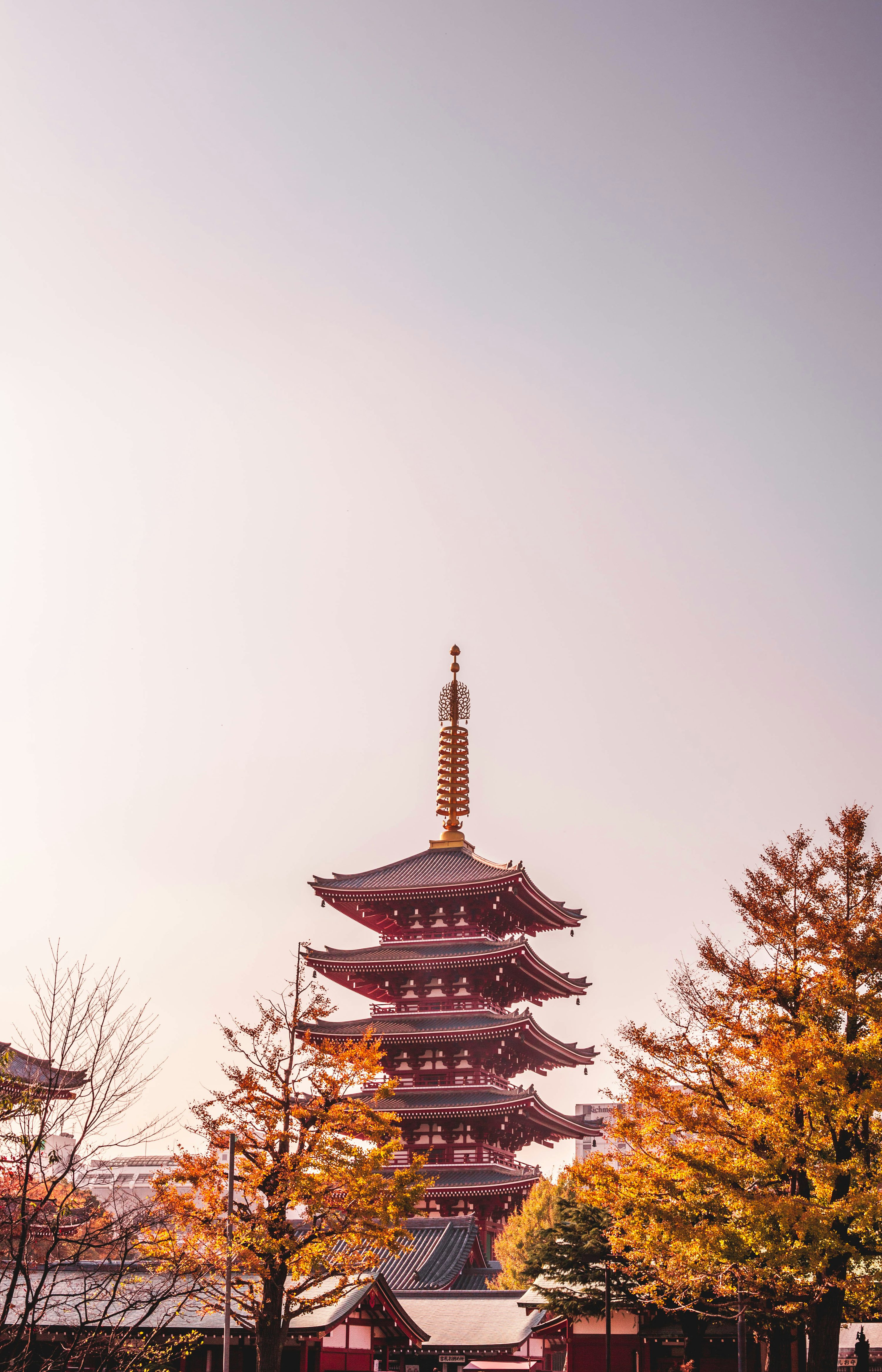
The five-story pagoda, first built in 942, has likewise been rebuilt multiple times through fire and war; the current version dates to 1973.

How to Get There
Senso-ji sits in the Asakusa district of Taito Ward, in northeastern central Tokyo. The nearest station is Asakusa Station, served by the Tokyo Metro Ginza Line, the Toei Asakusa Line, the Tobu Skytree Line, and the Tsukuba Express — one of the best-connected stations in the city.
| From | Route | Approx. time |
|---|---|---|
| Tokyo Station | JR Yamanote/Keihin-Tohoku to Kanda, then Ginza Line | ~25–30 min |
| Narita Airport | Keisei Skyliner/Access Express via Toei Asakusa Line | ~60–75 min |
| Haneda Airport | Keikyu Line direct to Toei Asakusa Line (no transfer) | ~35–50 min |
| Osaka / Kyoto | Tokaido Shinkansen to Tokyo, then subway | ~2.5–3 hours total |
Asakusa has one of the most convenient direct airport connections in Tokyo: from Narita, the Keisei Skyliner or Access Express runs via the Keisei Main Line, which through-services onto the Toei Asakusa Line straight to Asakusa Station without a detour through central Tokyo. From Haneda, the Keikyu Line similarly through-runs directly onto the Toei Asakusa Line — no transfer needed.
Visiting Tips
- Pass through Kaminarimon and walk the full length of Nakamise-dori, the roughly 250-meter approach lined with souvenir shops and traditional snacks, before reaching the main hall.
- Early morning (before 9am) is noticeably quieter than midday, when tour groups fill Nakamise-dori.
- The five-story pagoda and main hall are both free to view from outside; there’s no admission charge to enter the temple grounds.
- Combine a visit with nearby Tokyo Skytree, a short walk or one subway stop away across the Sumida River.
Getting There
Nearest station: Asakusa Station (Tokyo Metro Ginza Line / Toei Asakusa Line / Tobu Skytree Line)
All of Asakusa Station’s exits put you within about a 5-minute walk of Kaminarimon Gate and Senso-ji — Ginza Line Exit 1 is the closest, reaching the gate in about a minute.
FAQ
- Can visitors see the original Kannon statue? No. The statue has been kept hidden from public view since the 7th century, per temple tradition. A substitute image carved in 857 is displayed only once a year, on December 13.
- Is any part of Senso-ji original, or has it all been rebuilt? Virtually all of the current structures — the main hall (1958), Kaminarimon gate (1960), and five-story pagoda (1973) — are 20th-century reconstructions following fire, the Meiji-era anti-Buddhist movement, and WWII bombing. The site and its role as a place of worship, however, date back roughly 1,400 years.
- How is Senso-ji different from Asakusa Shrine next door? Senso-ji is a Buddhist temple; Asakusa Shrine, just beside it, is a separate Shinto shrine dedicated to the three men connected with the Kannon legend. Visiting both together is common, since they share the same grounds.

Don’t waste your first day in Japan hunting for WiFi
Install it before you board — your eSIM is already connected the second you land.
🏪 No shop visit
💳 No roaming bill shock
2-minute setup · works the moment you land
Leave a Reply