
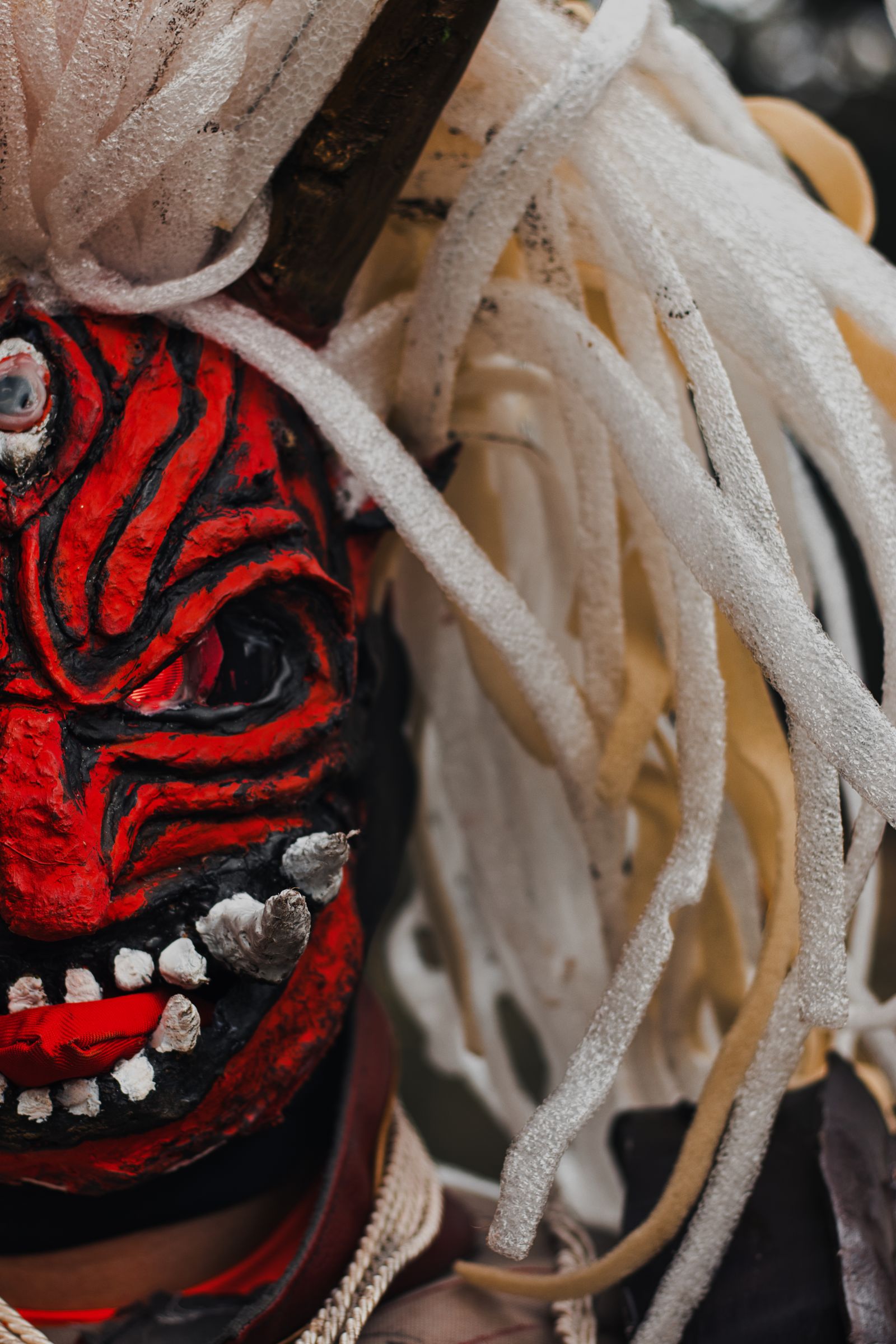

Quick answer: Namahage are demon-masked deities who visit homes on the Oga Peninsula in Akita Prefecture every New Year’s Eve, warning children against laziness and blessing households for the year ahead. Where the custom actually came from is genuinely unclear — at least four folk theories compete — but it has been documented since at least 1811, was named a national Important Intangible Folk Cultural Property in 1978, and was inscribed on UNESCO’s Intangible Cultural Heritage list in 2018.
Who Are the Namahage?
On the night of December 31, young men of Oga’s villages put on fearsome red or blue oni (demon) masks, straw capes called kede, and straw leggings, then go door to door through their communities carrying a large wooden knife and a bucket or tub. Bursting into homes, they roar the famous line “Naku ko wa inega, oya no iu koto kikanai ko wa inega” — “Are there any crying children? Any children who don’t listen to their parents?” — and scold both children and adults for laziness or bad behavior over the past year. Far from being purely frightening, the visit is understood as a blessing: after the household head formally welcomes the Namahage and offers food and rice wine, the Namahage in turn blesses the family with good health and a good harvest for the coming year before moving on to the next house.

Where the Tradition Came From: Four Competing Theories
Namahage folklore offers no single origin story, and researchers generally point to four possibilities that have circulated for generations. One traces the figures to yamabushi mountain ascetics who once practiced austerities in Oga’s hills. Another holds that they are messengers of the mountain deity (yama no kami). A third, more colorful legend claims a Chinese emperor once brought five oni to Oga as laborers, who ran wild until villagers tricked them into leaving. A fourth theory suggests the “demons” were originally foreign castaways who washed ashore on Oga’s coast — their unfamiliar appearance and language striking villagers as otherworldly. No single theory has been proven, and it’s likely that the tradition blended several strands of local belief over centuries.
The name itself has a more down-to-earth explanation: “namomi” is an old dialect word for the heat blisters that form on skin from sitting too long by an open hearth (irori) — a telltale sign of a lazy person who hasn’t been out working. “Hagu” means “to peel off” or “to strip away.” A namahage, in other words, is one who strips away both the blisters and the laziness they represent.
The Oldest Written Record: A Travel Diary from 1811
The earliest confirmed written account of the custom comes from Sugae Masumi (1754–1829), an Edo-period traveler and ethnographer who journeyed extensively through Tohoku recording local customs. In his travel diary “Oshika no Kankaze,” Sugae describes witnessing the ritual — which he recorded as “Namomihagi” — in the Miyazawa area of Oga on January 15, 1811 (Bunka 8), complete with illustrations. While the custom is almost certainly older than this account, it’s the oldest documented evidence historians can point to with confidence, which is why more ancient origin claims remain tradition rather than verified history.
From Village Ritual to UNESCO Intangible Cultural Heritage
The Namahage custom was designated a national Important Intangible Folk Cultural Property in 1978, formal recognition of its historical and cultural value within Japan. Forty years later, in December 2018, UNESCO added it to its Representative List of the Intangible Cultural Heritage of Humanity, grouping it together with nine other Japanese “raiho-shin” traditions — New Year rituals across Japan in which masked, costumed visitors are believed to be deities arriving from outside the community. That international recognition has turned what was once a purely local household custom into one of the signature cultural draws of Akita Prefecture.
Quick facts:
- Ritual takes place: New Year’s Eve (December 31), traditionally
- Earliest written record: 1811, in traveler Sugae Masumi’s diary
- National designation: Important Intangible Folk Cultural Property (1978)
- UNESCO listing: Intangible Cultural Heritage of Humanity (2018)
- Where to see it outside New Year’s Eve: Namahage-kan museum and Oga Shinzan Denshokan (year-round reenactments); Namahage Sedo Festival at Shinzan Shrine (second weekend of February)
How to Get There
The Oga Peninsula sits on Akita Prefecture’s coast, a bit off the main shinkansen line, so budget extra time for local transport.
- From Tokyo: Take the Akita Shinkansen “Komachi” from Tokyo Station to Akita Station, about 3 hours 40 minutes. Alternatively, fly Haneda to Akita Airport (about 70 minutes), then a limousine bus into Akita City (about 40 minutes).
- From Akita Station to Oga: Take the JR Oga Line directly to Oga Station, about 55 minutes.
- From Oga Station to the sights: The peninsula’s main attractions — the Namahage-kan museum, Shinzan Shrine, and the coastal viewpoint at Nyudo-zaki — are spread out, and there’s no regular fixed-route bus covering them. The practical option is the “Namahage Shuttle,” a reservation-based shared taxi service connecting Oga Station, Oga Onsen, Namahage-kan, and other key stops (roughly 25 minutes to Namahage-kan); a rental car or private taxi is the alternative for a more flexible day.
Visiting tips: Unless you have a personal connection or book a tour that arranges a household visit, most travelers experience Namahage through the two museums in Oga: Namahage-kan, which displays around 100 authentic masks and costumes from across the peninsula’s villages, and the adjacent Oga Shinzan Denshokan, an old farmhouse where staff perform a live reenactment of a Namahage household visit several times a day. For those visiting outside New Year’s, the Namahage Sedo Festival — held the second Friday through Sunday of February at Shinzan Shrine — combines Namahage performances with a fire ritual and is the most accessible way to see the tradition in a festival setting. Winters on the Oga coast are cold and can be snowy, so dress warmly.
FAQ
- Is Namahage meant to actually frighten children? It looks intense, but the intent is corrective and protective — scolding bad behavior while blessing the household — not malicious. Local children generally grow up understanding it as a New Year tradition rather than a real threat.
- Can tourists arrange to see a real household visit? On December 31 itself, some ryokan and tour operators arrange staged visits for guests, but casual visitors are far more likely to see the tradition at Namahage-kan’s reenactments or the February Sedo Festival.
- What do Namahage actually wear and carry? Oversized carved wooden or papier-mâché demon masks (typically red or blue), straw capes and leg wraps called kede, a large mock knife (deba), and a wooden tub or bucket for offerings.

Don’t waste your first day in Japan hunting for WiFi
Install it before you board — your eSIM is already connected the second you land.
🏪 No shop visit
💳 No roaming bill shock
2-minute setup · works the moment you land
Leave a Reply