
Quick answer: Sendai Castle, also known as Aoba Castle, was built in 1600–1601 on a defensible hilltop by Date Masamune, the one-eyed samurai lord who founded the city of Sendai. Almost nothing of the castle’s original buildings survives today — fire, the Meiji-era abolition of the domain system, and a 1945 bombing raid saw to that — but nearby, Masamune’s family shrine, Osaki Hachimangu, still stands as Japan’s oldest surviving example of “gongen-zukuri” shrine architecture, older even than the famous shrines of Nikko.
Building a Fortress on a Hill
After Date Masamune backed the winning side at the pivotal Battle of Sekigahara in 1600, Tokugawa Ieyasu granted him control over a large domain in what is now Miyagi Prefecture. Masamune wasted no time: construction on his new castle began in December 1600, on Mount Aoba, a defensible hill roughly 100 meters above the surrounding plain, and by 1601 he had also begun laying out the castle town that would grow into modern Sendai.
The site’s defensive value came at a cost to comfort — building a fortress on a steep hilltop was more about protection than convenience — but it reflected a lord who had spent his early career fighting for territory and wasn’t taking chances with his new domain’s security. Masamune ruled from Sendai for the rest of his life, and the Date clan continued to govern the region for over two and a half centuries afterward.
What’s Left of the Castle Today
Sendai Castle had a rough run over the following centuries. It endured the anti-feudal reforms of the Meiji Restoration in the 1870s, which dismantled Japan’s castle network nationwide; survived a major fire in 1882; and was then largely destroyed by Allied bombing raids in 1945, near the end of World War II. Notably, the castle never had a conventional multi-story keep (tenshu) to begin with — Masamune reportedly avoided building one, possibly to avoid provoking Tokugawa suspicion of his ambitions.

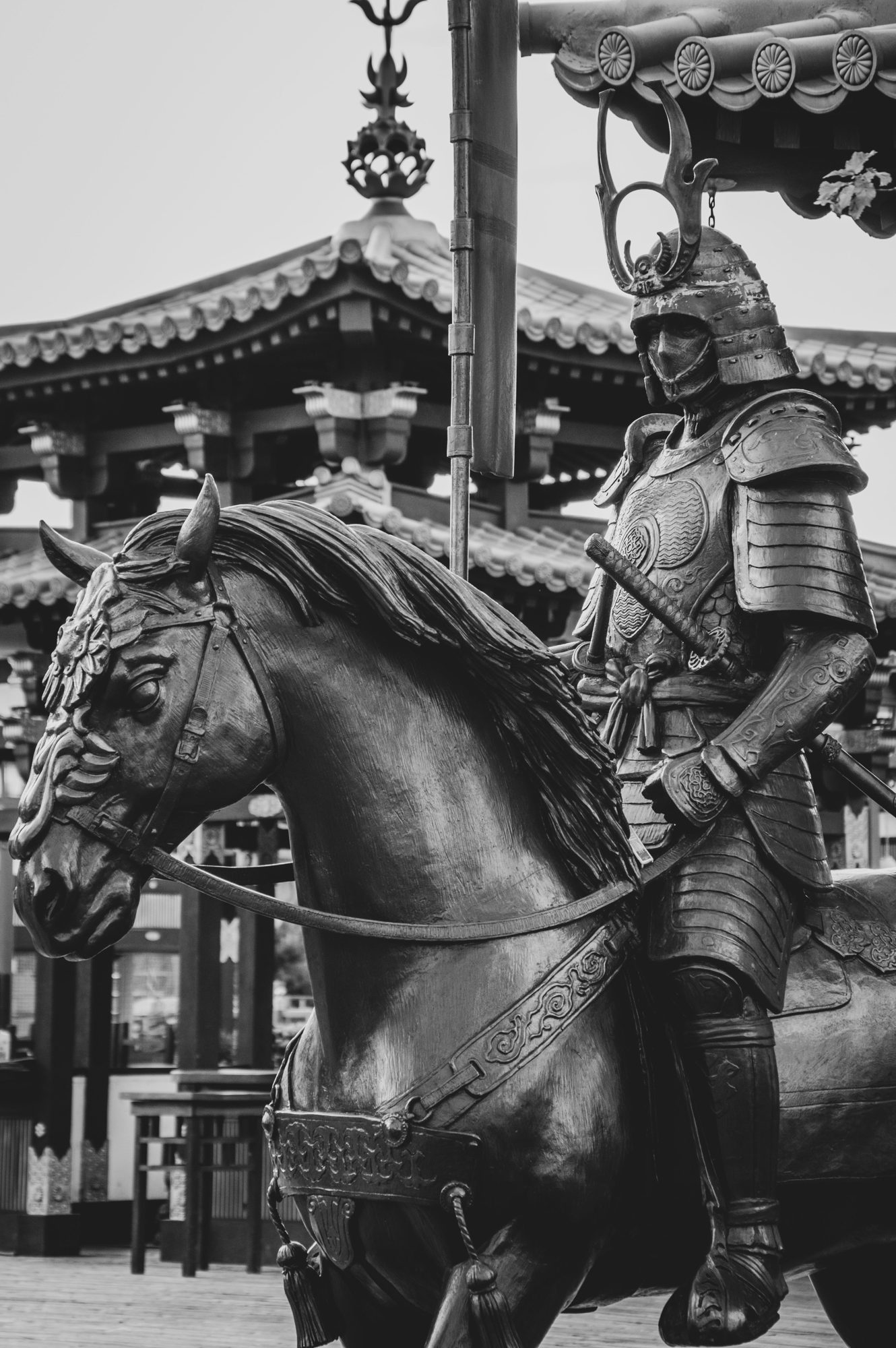
What remains today is mostly the castle’s outer stone walls, a reconstructed guard tower, and sweeping views over the city of Sendai from the former castle grounds. A prominent bronze equestrian statue of Date Masamune in full armor now marks the site, looking out over the city he founded — an image that has become one of Sendai’s most recognizable symbols, even though the statue itself is a modern addition rather than a historical structure.
Osaki Hachimangu: Japan’s Oldest Surviving Gongen-Zukuri Shrine
While the castle itself is largely gone, one of Masamune’s other major building projects survives almost entirely intact. Osaki Hachimangu, built on Masamune’s orders between 1604 and 1607, enshrines Hachiman, the guardian deity of war and of the Date clan itself. Masamune commissioned the finest craftsmen available for the project, and the resulting building is an elaborate example of Azuchi-Momoyama-period style — rich black lacquer, gold leaf, and dense ornamental carving throughout.
Architecturally, Osaki Hachimangu holds a specific distinction: it’s recognized as the oldest surviving example of gongen-zukuri shrine construction, a style that links a shrine’s main hall and worship hall via a connecting stone-floored room (ishi-no-ma) at a lower level. Because it was completed in 1607, a decade before the famous Nikko Toshogu shrine (completed 1617) popularized the same style further south, Osaki Hachimangu predates it as the style’s oldest surviving built example. It was designated a National Treasure in 1952.

Quick facts:
- Sendai Castle construction began: December 1600, under Date Masamune
- What survives: Outer stone walls and a reconstructed guard tower; no original keep or palace buildings
- Osaki Hachimangu built: 1604–1607, under Date Masamune
- Architectural distinction: Oldest surviving gongen-zukuri shrine in Japan, predating Nikko Toshogu
- National Treasure designation: 1952
How to Get There
Sendai is the largest city in the Tohoku region and a major Shinkansen hub in Miyagi Prefecture.
- From Tokyo: Take the Tohoku Shinkansen from Tokyo Station to Sendai Station. The ride takes about 90 minutes.
- To Sendai Castle Ruins (Aoba Castle): From Sendai Station, take the Loople Sendai sightseeing bus, a loop bus aimed at tourists that departs from bus stop 16 at the station’s west exit bus terminal. The ride takes about 20 minutes; get off at stop 5 (for the Sendai City Museum) or stop 6 (for the former castle grounds). A single ride costs around 260 yen, or 630 yen for an unlimited day pass, which is worth it if you plan to use the bus for multiple stops around the city.
- To Osaki Hachimangu: The same Loople Sendai bus serves the shrine at stop 11, about 20 minutes from the station by regular city bus for around 230 yen one-way. Alternatively, it’s about a 15-minute walk from Kunimi Station on the JR Senzan Line, itself about 15 minutes from Sendai Station.
- Both sites can reasonably be combined in a single half-day using the Loople bus’s day pass, though they sit on opposite sides of the city center, so plan for some travel time between them.
Practical tips: The castle ruins are best visited for the panoramic view over Sendai as much as for the historical remains themselves — arrive with reasonable weather for the best photos. Osaki Hachimangu is a working shrine, so dress and behave respectfully, and check ahead if visiting around New Year, when it hosts one of the region’s largest Dontosai fire festivals and draws large crowds. Both sites are outdoors and involve some walking on slopes or stairs.
Getting There
Nearest station: JR Sendai Station.
From the West Exit Bus Terminal at Sendai Station, the Loople Sendai sightseeing bus reaches the Site of Sendai Castle stop in about 22 minutes (¥260 per ride, or ¥630 for a day pass), just a 1-minute walk from the ruins. Alternatively, the Tozai Subway Line runs to International Center Station (5 minutes, ¥210), though it’s an uphill walk from there to the castle site.
FAQ
- Can visitors go inside the original Sendai Castle building? No — no original castle buildings survive. What’s left are stone walls, a reconstructed guard tower, and the site’s views, along with a museum near the grounds covering the castle’s history.
- Why didn’t Date Masamune build a castle keep? Historians generally believe Masamune deliberately avoided building an imposing multi-story keep to avoid appearing overly ambitious to the Tokugawa shogunate, which was wary of powerful regional lords in the years after Sekigahara.
- Is Osaki Hachimangu older than Nikko Toshogu? Yes — Osaki Hachimangu was completed in 1607, ten years before Nikko Toshogu’s 1617 completion, making it the oldest surviving example of the gongen-zukuri architectural style both shrines share.

Don’t waste your first day in Japan hunting for WiFi
Install it before you board — your eSIM is already connected the second you land.
🏪 No shop visit
💳 No roaming bill shock
2-minute setup · works the moment you land
Leave a Reply