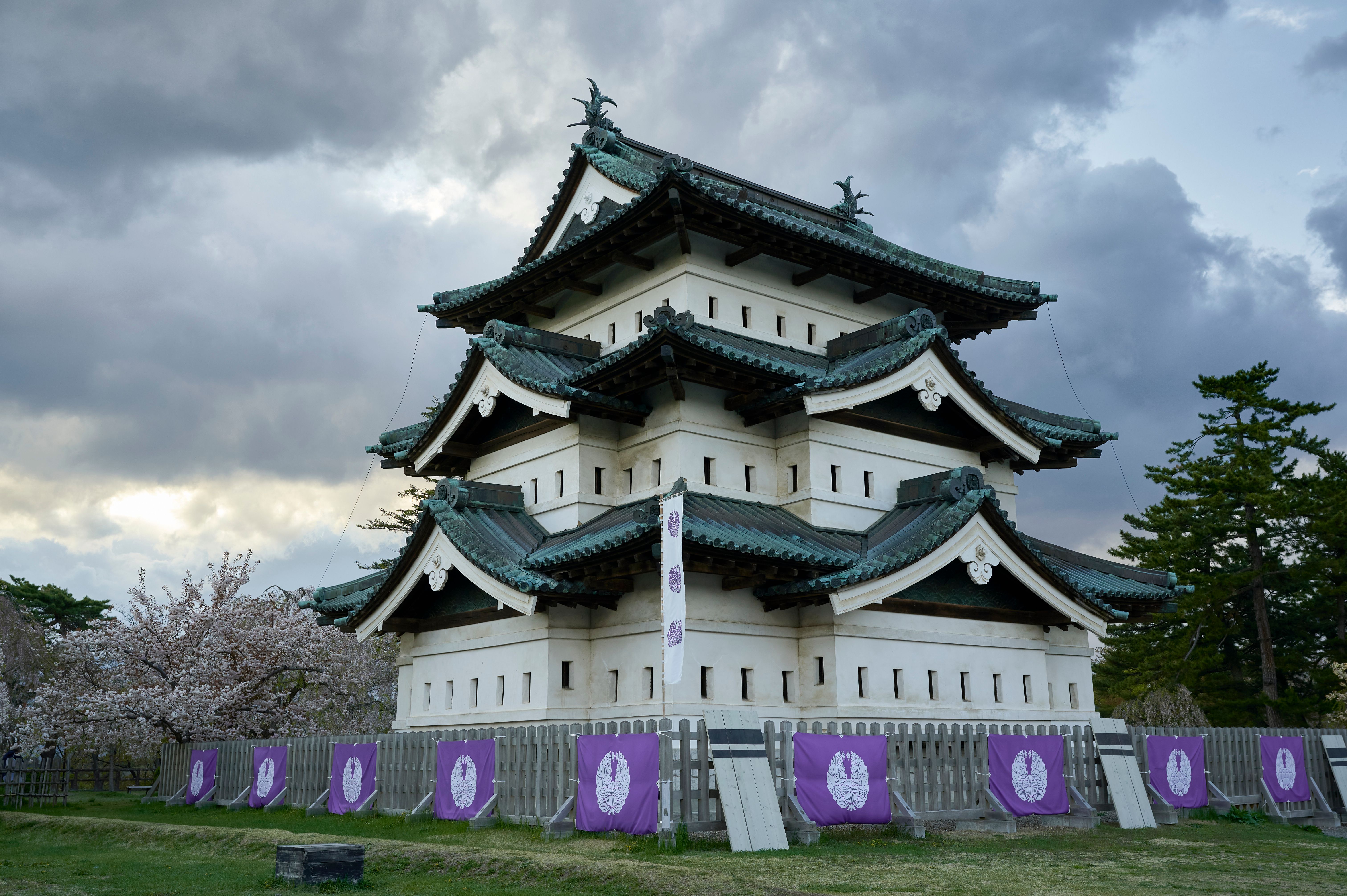
Quick answer: Hirosaki Castle in Aomori Prefecture was the seat of the Tsugaru clan throughout the Edo period and is one of only twelve castles in Japan that still has an original tower dating from that era — the northernmost of them all. Its current three-story keep, rebuilt in 1810 after the first tower burned down, sits inside a park famous for having one of Japan’s most celebrated cherry blossom displays.

The Tsugaru Clan’s Rise
Hirosaki Castle owes its existence to Tsugaru Tamenobu, a Sengoku-era warlord who broke away from the powerful Nanbu clan to establish independent control over the Tsugaru region in what is now western Aomori Prefecture. In 1603, Tamenobu ordered the development of a castle town at Takaoka, laying the groundwork for what would become Hirosaki, but he died in Kyoto in 1607 before construction of the castle itself began. It fell to his son and successor, the second lord Tsugaru Nobuhira, to see the project through — the castle was finally completed in 1611, becoming the seat of the Tsugaru domain for the rest of the Edo period.
A Tower Lost to Lightning
The original castle had a five-story, five-floor tenshu (keep) — a genuinely imposing structure by the standards of northern Japan at the time — positioned at the southwest corner of the main bailey. It stood for little more than a decade and a half: in 1627, a lightning strike is recorded to have burned it down entirely, leaving the domain without a proper keep for nearly two centuries.
A Clever Workaround Under Shogunate Law
By the early 1800s, the Tokugawa shogunate’s laws governing the daimyo (buke shohatto) placed tight restrictions on castle construction, effectively banning the rebuilding of tenshu keeps without special permission. The ninth Tsugaru lord, Yasuchika, got around this in 1810 by petitioning to build a “yagura” — a turret, officially justified as a coastal defense measure — rather than a new tenshu. The structure he built was, in every practical sense, a new castle tower in miniature: three stories instead of five, more modest in scale, but unmistakably a keep. That building is the one still standing today, making Hirosaki one of just twelve castles in Japan that retain a tower actually built during the Edo period, and the northernmost of them all.
From Feudal Seat to Public Park
With the abolition of the domain system in the Meiji era, Hirosaki Castle’s grounds were opened to the public as Hirosaki Park, one of the earlier examples in Japan of a former daimyo castle being converted into public green space rather than being demolished. Roughly 2,600 cherry trees were later planted across the park’s six baileys — honmaru, kita-no-kuruwa, ninomaru, sannomaru, yonomaru, and nishi-no-kuruwa — and today the Hirosaki Sakura Matsuri draws crowds who come specifically to see cherry blossoms framed against the old castle moats, widely considered among the most beautiful cherry blossom scenes in Japan.

How to Get There
From Tokyo: Take the Tohoku Shinkansen from Tokyo Station to Shin-Aomori Station, the fastest journey taking about 2 hours 59 minutes. From Shin-Aomori, transfer to a JR Ou Line limited express or rapid/local train bound for Hirosaki; the ride takes roughly 30–40 minutes depending on the service. Total travel time from Tokyo is typically 3.5–4 hours.
By air: Fly from Tokyo Haneda to Aomori Airport (about 1 hour 20 minutes), then take the airport limousine bus to Hirosaki Station, which takes approximately 54–55 minutes.
From Osaka: There’s no direct Shinkansen connection and limited direct flights to Aomori, so most travelers route through Tokyo by air or Shinkansen, or fly into Aomori if a seasonal direct route is available.
From Hirosaki Station to the castle: It’s about a 25–30 minute walk. Alternatively, take the 100-yen Dote-machi loop bus to the “Shiyakusho-mae” (City Hall) stop, about a 15-minute ride, then walk roughly 4 minutes to the park entrance.
| Route | Time |
|---|---|
| Tokyo → Shin-Aomori (Shinkansen) | ~2h59m |
| Shin-Aomori → Hirosaki (JR Ou Line) | 30–40 min |
| Haneda → Aomori Airport (flight) | ~1h20m |
| Aomori Airport → Hirosaki Station (limousine bus) | 54–55 min |
| Hirosaki Station → Castle (on foot) | 25–30 min |
Visiting Tips
- Cherry blossom season is intense: Late April to early May draws huge crowds for the Sakura Matsuri — book accommodation well in advance if visiting then.
- Try the moat boat ride: Small boats operate on the park’s moat in spring, offering a different vantage point on the castle and its cherry trees.
- Off-season appeal: Autumn foliage and the winter Snow Lantern Festival offer quieter, equally scenic alternatives to the spring rush.
FAQ
Q: Is the current tower the original one built in 1611?
A: No. The original five-story tower burned down after a lightning strike in 1627; the three-story tower standing today was built in 1810 as a reconstruction.
Q: Why is it called one of Japan’s “12 surviving original castles”?
A: Because its current tower genuinely dates from the Edo period, unlike the many Japanese castles whose towers are 20th-century concrete reconstructions.
Q: How much time should I plan for a visit?
A: About 1.5–2 hours to walk the grounds and see the tower’s interior museum; add more time during cherry blossom season if you want to fully enjoy the park.
Getting There
Nearest station: Hirosaki Station (JR Ou Line & Konan Railway)
From Hirosaki Station, the Dotemachi Loop Bus or Konan Bus Loop Line reaches the “Shiyakusho-mae” stop next to the castle park in about 15–20 minutes for ¥150–200. Walking takes around 30 minutes, and a taxi from the station is about 10 minutes.

Don’t waste your first day in Japan hunting for WiFi
Install it before you board — your eSIM is already connected the second you land.
🏪 No shop visit
💳 No roaming bill shock
2-minute setup · works the moment you land
Leave a Reply