
Quick answer: Sengan-en is a landscape garden in Kagoshima built in 1658 as a private retreat for the Shimazu clan, the feudal lords of Satsuma domain. Its signature feature is “borrowed scenery” — using Sakurajima volcano and Kinko Bay as a living backdrop instead of building an artificial hill and pond. Two centuries later, it became the birthplace of the Shuseikan Project, a cluster of Western-style factories that helped launch Japan’s industrial revolution, and it’s now part of a UNESCO World Heritage Site.
A Daimyo’s Garden, Built in 1658
Sengan-en was built in 1658 (Manji 1) by Shimazu Mitsuhisa, the 19th head of the Shimazu clan, as a private villa and garden for the family that had ruled Satsuma domain (present-day Kagoshima) for nearly 500 years. The Shimazu were one of the most powerful and enduring daimyo families in Japan, and Sengan-en served for generations as their retreat, entertaining space, and eventually, as the setting for one of the most consequential industrial projects in 19th-century Japan.
Borrowed Scenery: Turning a Volcano Into a Garden Feature
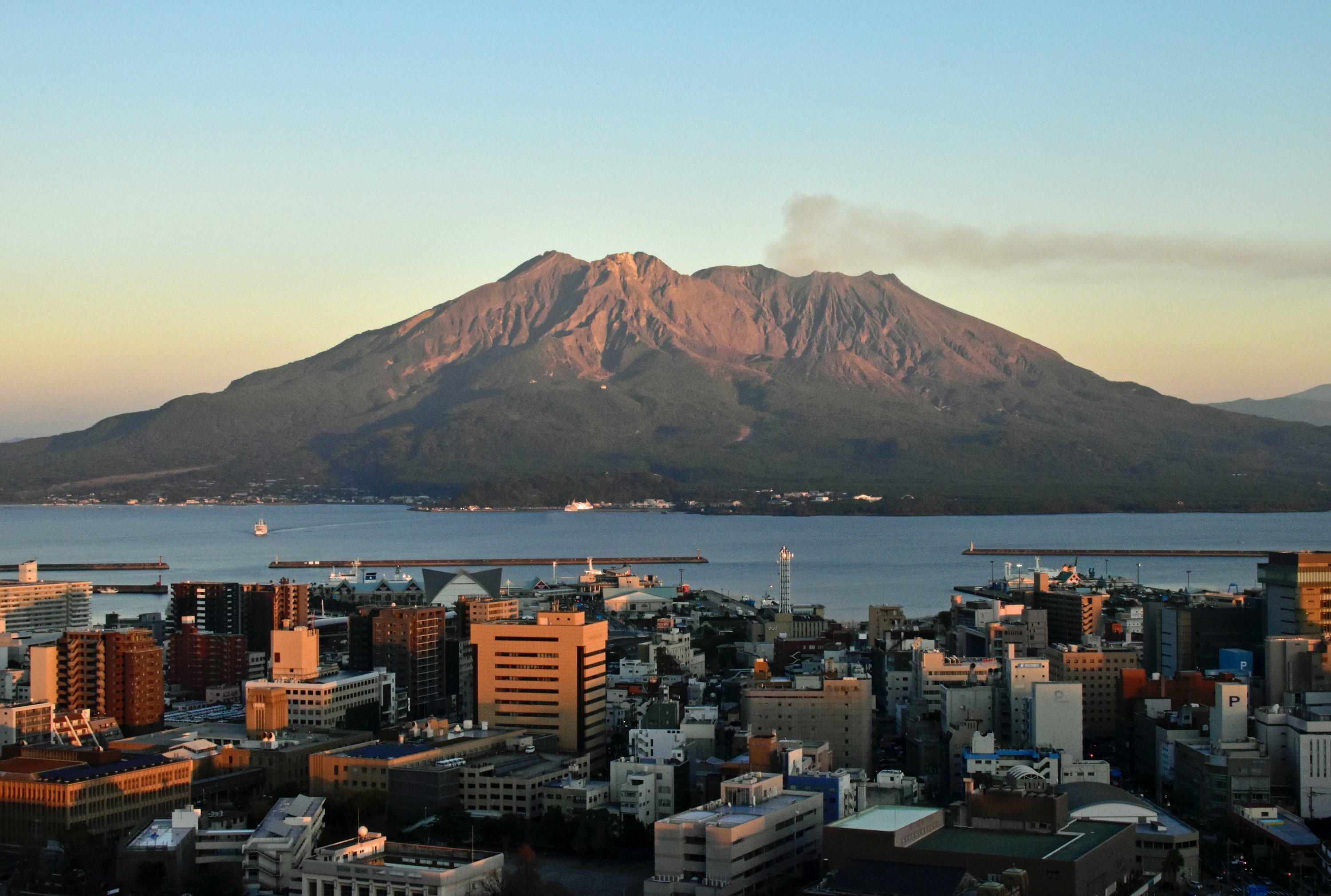
What makes Sengan-en distinctive among Japan’s daimyo gardens is its use of shakkei, or “borrowed scenery” — a design technique where a garden incorporates a distant natural landscape as if it were part of the garden itself, rather than building everything within its own walls. Instead of constructing an artificial hill and pond, as most formal Japanese gardens do, Sengan-en’s designers used the real Sakurajima volcano across the water as the garden’s “hill” and the waters of Kinko Bay as its “pond.” The effect is striking and remains largely intact today: from the right vantage points in the garden, the active volcano appears to loom directly over the grounds, folded seamlessly into the landscape design.

The Shuseikan Project: Japan’s Industrial Revolution Starts Here
Sengan-en’s most historically significant chapter began in the 1850s, when Shimazu Nariakira — the same Satsuma lord remembered elsewhere for proposing the hinomaru flag in 1854 — used the grounds around Sengan-en to launch the Shuseikan Project (集成館事業). Alarmed by Western military and industrial power after witnessing the Opium War’s effect on China, Nariakira built Japan’s first Western-style industrial complex here: reverberatory furnaces for iron smelting and cannon casting, a glassworks, a shipyard, spinning mills, and other facilities, all developed using Western technical texts and, in some cases, reverse-engineered Western equipment. It amounted to a remarkably early attempt by a single feudal domain to industrialize on a Western model, years before the Meiji government’s own national modernization drive began in 1868.

A Garden Full of “Japan’s Firsts”
Nariakira’s fascination with Western science shows up in specific, still-visible corners of the garden. The stone “Tsuru Doro” (Crane Lantern) near the shore is where, in August 1857, Nariakira had his engineers install a gas chamber and ignite Japan’s first gas lamp — predating gas street lighting in Yokohama and Tokyo by well over a decade. That same year, Nariakira also sat for a daguerreotype portrait as part of his research into Western photographic technology; the resulting image is recognized today as the oldest surviving photograph of a Japanese person, and it’s registered as an Important Cultural Property. Both projects were part of the same broad push behind the Shuseikan Project — using Sengan-en as a testing ground for whatever Western technology Nariakira could get his hands on.
A World Heritage Site
The Shuseikan Project’s surviving structures — including the reflecting furnace ruins and other facilities in and around Sengan-en — are today registered as part of the UNESCO World Heritage Site “Sites of Japan’s Meiji Industrial Revolution: Iron and Steel, Shipbuilding and Coal Mining,” inscribed in 2015. The listing spans 23 component sites across eight prefectures, and the Kagoshima cluster around Sengan-en is recognized as one of the earliest starting points of that industrial story, predating most of the other listed sites by a decade or more.
Quick facts:
- Built: 1658 (Manji 1), by Shimazu Mitsuhisa
- Design feature: Shakkei (“borrowed scenery”) using Sakurajima and Kinko Bay
- Key later figure: Shimazu Nariakira, who launched the Shuseikan Project here in the 1850s
- World Heritage status: Part of “Sites of Japan’s Meiji Industrial Revolution,” inscribed 2015
Practical tips: Sengan-en is about a 30-minute bus ride from central Kagoshima and is usually combined with a visit to the adjoining Shoko Shuseikan museum, which displays artifacts and explains the Shuseikan Project in more depth. Try to visit on a clear day — the whole point of the garden’s design is the view of Sakurajima, which is easily missed on an overcast one.
Getting There
Nearest station: JR Sengan-en Station (JR Nippo Main Line)
A new station right next to the garden opened in March 2025, just 8 minutes from Kagoshima-Chuo Station for ¥240. Alternatively, the Kagoshima City View sightseeing bus reaches the “Sengan-en-mae” stop from Kagoshima-Chuo Station in about 20–30 minutes.
FAQ
- Is this the same Shimazu lord connected to Japan’s flag? Yes — Shimazu Nariakira, who developed the Shuseikan Project at Sengan-en, is the same Satsuma daimyo credited with proposing the hinomaru as Japan’s ship flag in 1854. The two stories intersect through him, though they’re otherwise separate chapters of his life.
- Is Sengan-en itself a UNESCO World Heritage Site? The garden’s associated industrial facilities (the reflecting furnace ruins and related Shuseikan sites) are registered components of the wider “Sites of Japan’s Meiji Industrial Revolution” listing; the garden functions today as a historic landscape and museum grounds around that heritage.
- How long does a visit take? Most visitors spend around 1.5 to 2 hours covering the garden and the adjoining Shoko Shuseikan museum, longer if you take a guided tour of the historic buildings.

Don’t waste your first day in Japan hunting for WiFi
Install it before you board — your eSIM is already connected the second you land.
🏪 No shop visit
💳 No roaming bill shock
2-minute setup · works the moment you land
Related Guides
Leave a Reply