
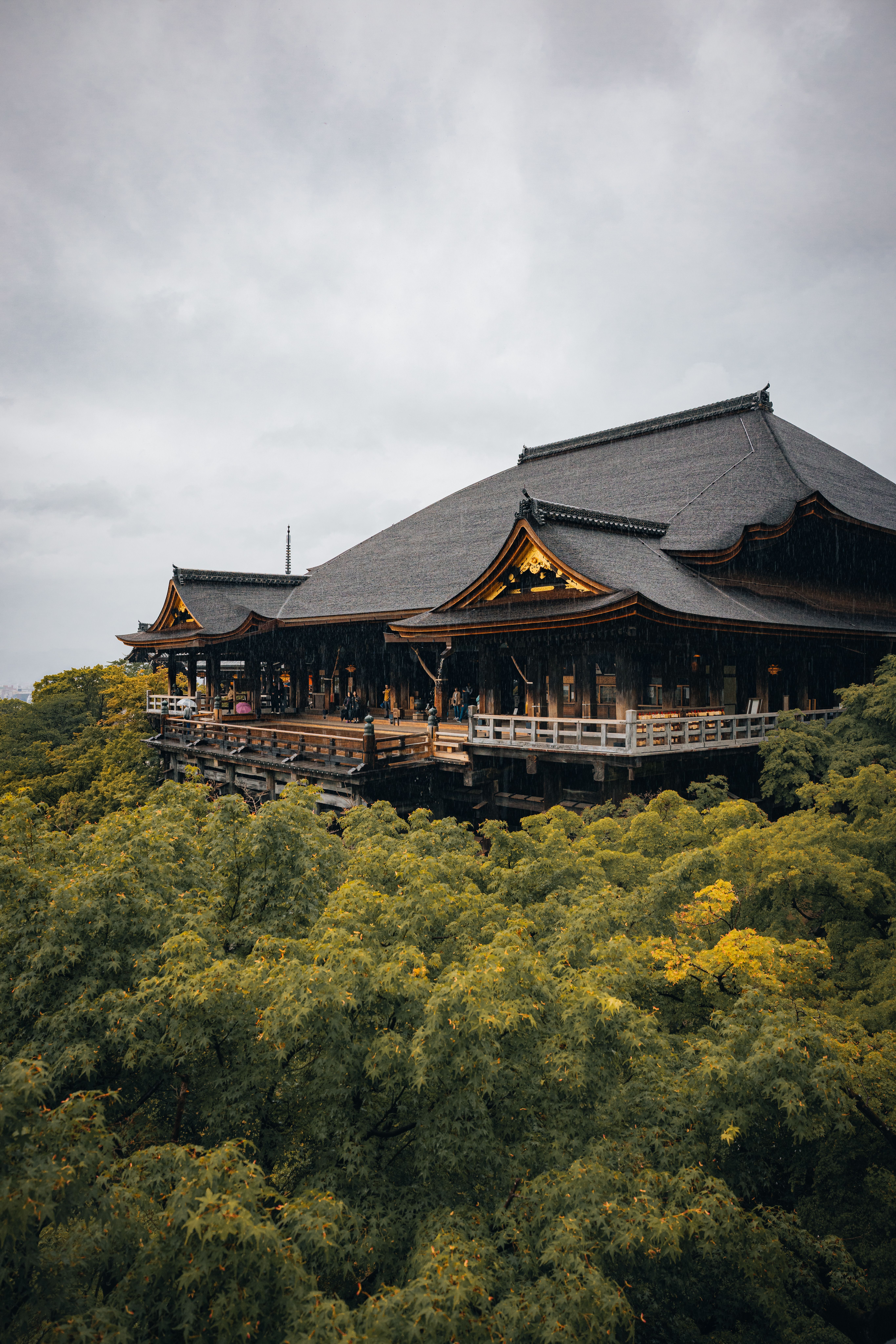

Quick answer: Kiyomizu-dera is traditionally said to have been founded in 778 by a monk named Enchin, with the warrior Sakanoue no Tamuramaro credited with building its first main hall soon after. The temple’s famous wooden stage — built out over the hillside without a single nail — and the main hall behind it were both rebuilt in 1633 under the sponsorship of the shogun Tokugawa Iemitsu, and that Edo-period building is what visitors see today. It’s part of the UNESCO World Heritage Site “Historic Monuments of Ancient Kyoto,” registered in 1994.
A Temple Founded by a Dream, According to Legend
Kiyomizu-dera’s origin story, as preserved in temple tradition, begins in 778, near the very end of the Nara period, before Kyoto had even become Japan’s capital. A monk named Enchin (also known earlier in life as Kenshin) is said to have had a vision instructing him to follow the Kizu River in search of a pure spring. He found one at the base of Mount Otowa, in what’s now eastern Kyoto, where he met an ascetic who gave him sacred wood. From it, Enchin carved a statue of Kannon, the bodhisattva of mercy, and built a small hermitage to house it — the seed of what would become Kiyomizu-dera. The temple’s name literally means “Pure Water Temple,” a direct reference to that spring, which still flows today as the Otowa Waterfall.
Sakanoue no Tamuramaro and the First Main Hall
According to the same tradition, the general Sakanoue no Tamuramaro — one of the most celebrated military commanders of the early Heian period — came across Enchin while hunting deer in the same hills. Moved by the monk’s teachings on the sanctity of life, Tamuramaro is said to have become a devoted follower of Kannon and to have donated a proper hall to enshrine the statue, laying the foundation for the temple as an institution. This connection to Tamuramaro, one of the great heroes of early Japanese history, helped establish Kiyomizu-dera’s prestige early on.

The Kiyomizu Stage: Built Without a Single Nail
The temple’s most iconic feature is the butai, or stage — a wooden platform that juts out roughly 13 meters above the hillside from the front of the main hall, supported by more than 100 tall wooden pillars. It’s built using a traditional cantilevered technique called kake-zukuri, developed for construction on steep slopes and cliffs, and famously assembled using interlocking joinery and wooden pegs rather than a single metal nail.
The stage’s height gave rise to a well-known Japanese expression: Kiyomizu no butai kara tobioriru — “to jump off the stage at Kiyomizu” — used today to mean taking a bold, all-or-nothing leap of faith on a big decision. During the Edo period, some visitors reportedly did attempt the jump for real, believing that surviving it would grant a wish; the practice was eventually banned.
Destroyed by Fire, Rebuilt in 1633
Like many of Kyoto’s wooden temples, Kiyomizu-dera burned down multiple times over its long history. The version standing today — both the main hall and its stage — was rebuilt in 1633, sponsored by the third Tokugawa shogun, Tokugawa Iemitsu, as part of a broader Edo-period effort to restore and patronize major temples across the country. That 1633 hall is now designated a National Treasure of Japan.

A UNESCO World Heritage Site
Kiyomizu-dera is one of seventeen locations included in “Historic Monuments of Ancient Kyoto,” a UNESCO World Heritage Site registered in 1994 that also includes landmarks such as Kinkaku-ji (the Golden Pavilion) and Nijo Castle. The listing recognizes the role these sites played in the development of Japanese religious architecture, garden design, and culture across more than a thousand years as Kyoto served as the imperial capital.
Timeline at a Glance
| Year | Event |
|---|---|
| 778 | Kiyomizu-dera traditionally founded by the monk Enchin |
| Early Heian period | Sakanoue no Tamuramaro credited with building the temple’s first main hall |
| 1633 | Current main hall and stage rebuilt under the patronage of Tokugawa Iemitsu |
| 1994 | Registered as part of the UNESCO World Heritage Site “Historic Monuments of Ancient Kyoto” |
Visiting Today
Most visitors approach up the sloping, shop-lined lanes of Higashiyama before reaching the temple gates. The view from the stage — out over a forested valley toward the Kyoto skyline — is at its most dramatic during cherry blossom season in spring and the maple-leaf season in autumn, when the temple also holds special night illuminations.
Getting There
Nearest station: Keihan Kiyomizu-Gojo Station, though most visitors arrive by bus.
Kiyomizu-dera sits on a hillside without a train station right at its gates. From Keihan Kiyomizu-Gojo Station it’s roughly a 25-minute walk uphill, so most visitors instead take a city bus: from JR Kyoto Station, board bus No. 100 or 206 and get off at the Gojo-zaka stop, from which it’s about a 10-minute walk up to the temple.
FAQ
- Is the current building really from 1633, or has it been touched up since? The 1633 main hall and stage are the structures visitors see today; they’ve undergone conservation and repair work over the centuries, but the core Edo-period construction is what remains, which is why it’s a National Treasure.
- What does “built without a nail” actually mean? It refers to the stage’s wooden substructure, which uses interlocking joints and wooden pegs rather than metal nails or fasteners — a traditional Japanese carpentry technique suited to a structure that needs to flex slightly during earthquakes.
- Can you still jump off the stage? No — the historical practice of jumping was banned in the 19th century, and today the stage has railings and is purely for viewing.

Don’t waste your first day in Japan hunting for WiFi
Install it before you board — your eSIM is already connected the second you land.
🏪 No shop visit
💳 No roaming bill shock
2-minute setup · works the moment you land
Related Guides
Leave a Reply